2026-11-10
Can a High Double Eyelid Crease Be Lowered? What to Check Before Revision
Depending on the cause, revision that adjusts the height can be planned for a crease set too high. Here is why a crease looks high and what determines how much it can be lowered.
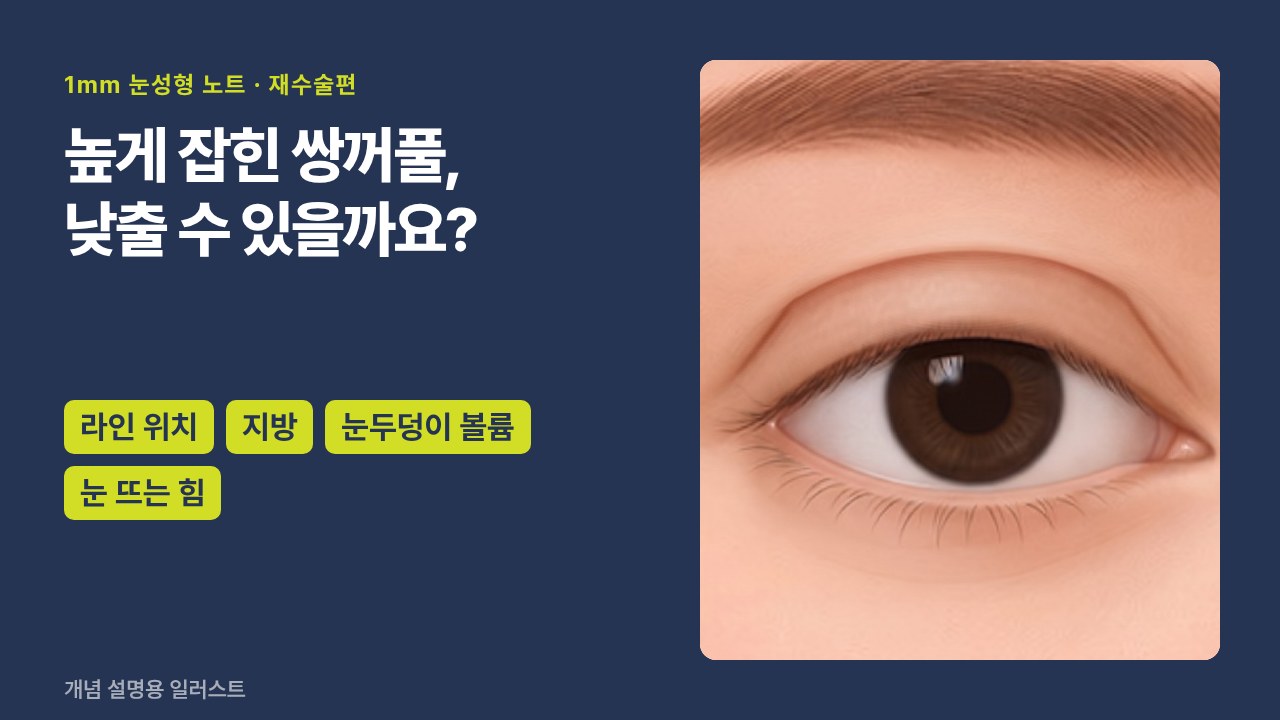
When a double eyelid crease settles higher than expected, you may feel that your eyes look overly heavy or sleepy. Depending on the cause, revision surgery that adjusts the crease height can be planned for a crease that was set too high. However, a crease may look high for reasons other than its position alone, so lowering the height alone does not solve everything.

Lowering a high double eyelid crease: is it possible?
People who feel their crease turned out higher than expected after double eyelid surgery often find themselves thinking like this.
A common thought
If the crease were just a little lower, wouldn’t I get the eyes I wanted?
1mm Plastic Surgery’s double eyelid revision guide explains a crease that looks too thick as a case where the crease was set too high, or excess fat was not adequately removed. Revision is then planned in the direction of removing fat or adjusting the crease height, depending on the cause, to create a natural-looking crease.
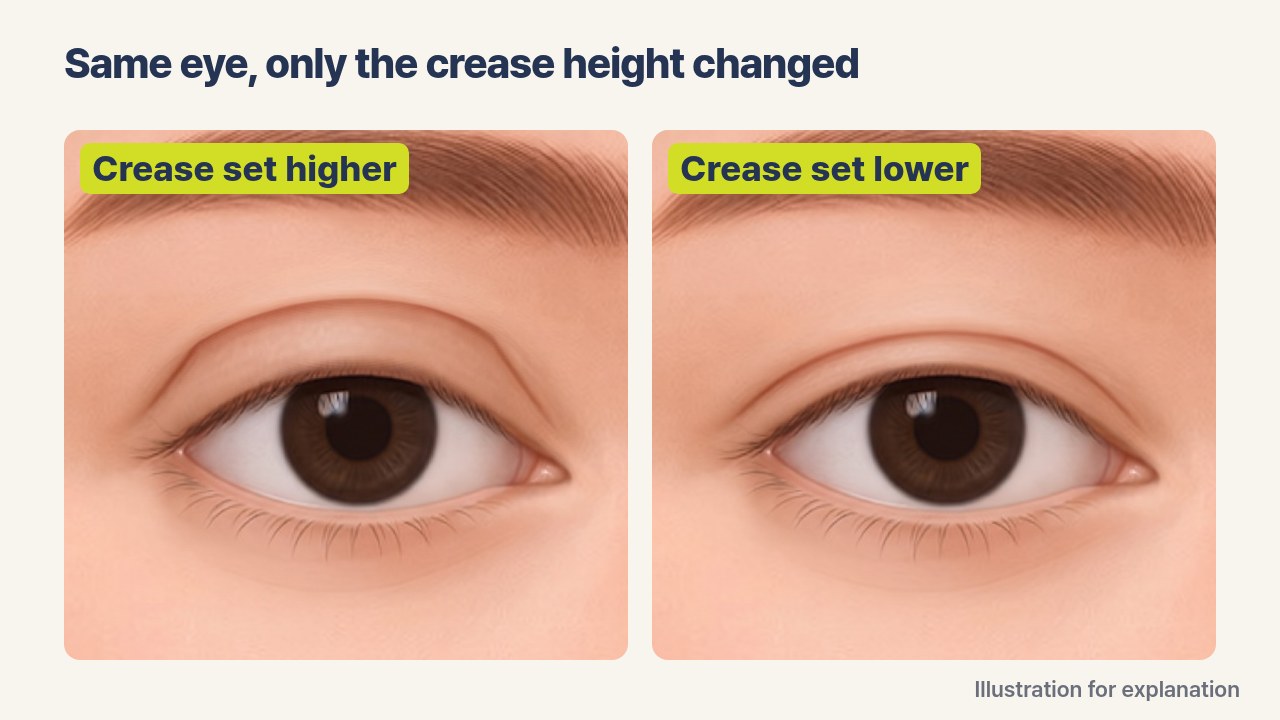
But the impression that a crease ‘looks high’ may not come from its position alone. That is why lowering revision starts by first checking “why does it look high?” rather than “how far should it come down?” All six cases that lead people to consider revision are summarised in an earlier article. This article looks closely at just one of them: the crease set too high.
When a crease looks high, what is checked together?
Even when every case looks the same from the outside — ‘the crease is high’ — several things are checked together during the examination.

- Crease position — The crease was set too high in the previous surgery. This is one cause of a “sausage eyelid”, where the crease looks thick, and adjusting the crease height becomes the main focus.
- Fat below the crease — Excess fat was not adequately removed, so the area below the crease looks puffy. This is another cause of a sausage eyelid, and fat removal may be planned as well, depending on the cause.
- Upper-eyelid volume — If too much fat or muscle was removed from the upper eyelid, several creases may form, and on a hollow upper eyelid it can be difficult to set the crease properly. In such cases, ways to restore volume are sometimes considered as well.
- Eye-opening strength — Double eyelid surgery addresses the crease, while ptosis correction addresses the strength used to open the eyes. If there are ptosis symptoms and only double eyelid surgery is done, the crease may look loosened or the eyes may look sleepy, so eye-opening strength is checked as well.
The key point
Two or more causes may overlap. Which cause plays how large a part cannot be decided from drawings or photos alone; it is confirmed by examination.
What determines the height of a double eyelid crease?
Crease height is decided separately for each eye. 1mm Plastic Surgery’s guide to natural-adhesion (suture-method) double eyelid surgery explains that it analyses the shape of the eye, eye-opening strength, the muscles, skin thickness and facial asymmetry, and sets the crease height taking into account how the eyes look open and closed, and harmony with the face as a whole. The incisional double eyelid guide also explains that it considers each person’s eye condition and overall harmony.
In revision, the problems with the previous surgery and the current condition of the eye are checked first. This is because an eye that has already had surgery may have a different tissue condition from the first time.
- Crease height — The higher the crease is set, the thicker the double eyelid may look when the eyes are open.
- Crease starting point — In-line, in-out line, semi-out line and out-line are classified by where the crease starts near the inner corner of the eye. An out-line is a crease that does not touch the inner corner and appears high.
So a concern that ‘the crease is high’ is sometimes really dissatisfaction with the crease’s starting point or shape. In consultation, it helps to break down specifically what you are unhappy with.
How is revision to lower the crease planned?
In the incisional method, the skin is incised along the designed line, excess fat and part of the muscle are removed, and the crease is then made with a fixation suture joining the incised skin to the tarsal plate (the firm plate inside the eyelid).

Revision is surgery that works again on a crease made this way and the tissue around it. That is why removing scar tissue from the previous surgery and minimising tissue damage during the operation are important. The plan is generally made in the order below.
- Identifying the cause — Checking which of crease position, fat below the crease, upper-eyelid volume and eye-opening strength is involved.
- Designing the new crease height — Deciding it again, taking into account each person’s eye condition and harmony with the face as a whole.
- Choosing methods by cause — Deciding on crease height adjustment, fat removal and so on, depending on the cause, and considering whether to include eye-opening strength or volume issues in the plan if they are also present.
Who revision is for and how each case is improved can also be found in 1mm Plastic Surgery’s double eyelid revision guide.
What affects how much a crease can be lowered?
Even with the same ‘high crease’, how much it can be lowered, and by what method, differs from person to person. The examination looks at the following factors together.
- Current crease height and thickness — How it looks with the eyes open and with them closed
- Amount of upper-eyelid fat — Whether the area below the crease is puffy or, conversely, hollow
- Eye-opening strength and left–right differences — Whether it is a crease issue or an eye-opening strength issue
- Adhesions and scars from the previous surgery — How much scar tissue there is
- Current skin condition — Skin thickness and sagging
- The crease and eye shape you want — Not only height but also starting point and shape
Aligning expectations
The change you can expect from revision may differ depending on the current condition of the eyelid. If you have a height in mind, share it fully in consultation, but it is good to also know that depending on the examination, it may not always be possible to achieve exactly the height you want.
When can revision be done, and what should you be careful about?
After eye surgery, it usually takes about 6 months to 1 year for scars to heal, swelling to subside and things to settle. That is why it is best to have double eyelid revision at least 1 year later. An accurate diagnosis is possible only once the eye tissues are stable. However, at the surgeon’s discretion, revision is sometimes done in the early period after surgery, before the scar hardens.

The reasons behind the timing are explained in more detail in our article on revision timing. Before your consultation, it helps to note down the following.
- When and how the previous surgery was done — If you know whether it was the incisional method or the suture method, please let us know.
- What bothers you most — Crease height, thickness, shape or the difference between the two sides
- The improvement you want — What kind of crease and eye shape you would like
Side effects
With double eyelid revision too, the result and recovery may differ depending on your eye condition and surgical history, and side effects such as swelling and bruising, asymmetry, inflammation and infection, scarring, and crease loosening may occur. Existing scars cannot be removed entirely. If you notice any unusual symptoms after surgery, please tell the clinic that performed it right away.
High double eyelid crease revision: frequently asked questions
Can a double eyelid crease that was set too high be lowered?
When the crease was set too high or excess fat was not adequately removed, revision is planned to adjust the crease height or remove fat, depending on the cause. How much it can be lowered and how may differ depending on the current condition of the eyelid, so this is confirmed by examination.
My first surgery used the suture method. Does revision have to be incisional?
Not necessarily. However, if you have had double eyelid surgery before, the incisional method may be needed in some cases, depending on current adhesions, scars, skin condition and so on.
Are a high crease and a “sausage eyelid” the same thing?
1mm Plastic Surgery’s double eyelid revision guide lists two causes of a crease that looks too thick (a “sausage eyelid”): the crease was set too high, and excess fat was not adequately removed. So the examination checks whether it is due to the crease height, the remaining fat, or both.
If my crease is high and my eyes look sleepy, do I also need ptosis correction?
Not in every case. Double eyelid surgery addresses the crease, while ptosis correction addresses the strength used to open the eyes. The scope of surgery needed may differ depending on whether ptosis symptoms (weak eye-opening strength) are also present, so eye-opening strength is checked during the examination.
What happens in consultation
Before deciding how far to lower it,
we check why it looks high
- Checking what you are currently unhappy with
- Examining your eyes after the previous surgery
- Checking eye-opening strength and left–right differences
- Discussing the improvement you want and the surgical plan
We check your current eye condition and surgical history before discussing the direction of revision. Results and recovery may differ from person to person.
Consultation and booking
| Enquiries |
[email protected]
Getting in touch in advance can help reduce your waiting time. |
|---|---|
| Telephone | +82-2-552-1171 |
| +82 10-9451-1171 | |
| Opening hours |
Weekdays 10:00 – 19:00 Saturday 10:00 – 16:00 Closed Sundays and public holidays — for holiday opening, please check the monthly schedule notice. |
| Address | 7th, 8th, 9th and 10th floors, Youngshin Building, 449 Gangnam-daero, Seocho-gu, Seoul
In front of Sinnonhyeon Station Exit 7, a 2-minute walk |
| Website | 1mmpsglobal.com |
#DoubleEyelidRevision #HighDoubleEyelidCrease #LoweringDoubleEyelidCrease #SausageEyelid #RevisionTiming #EyeSurgery #1mmPlasticSurgery #KoreanUnderEyeFatSurgery #EpicanthoplastySurgery #JuvelookSkinBooster
This post was written by the founder of a medical institution to provide medical information. The procedure information is based on 1mm Plastic Surgery’s guide pages for double eyelid revision, incisional double eyelid surgery, suture-method double eyelid surgery, ptosis correction, upper-eyelid fat grafting/removal and eye-corner (canthoplasty) restoration. The eye images in this post are explanatory illustrations and diagrams to aid understanding; they do not show real people and are not before-and-after comparisons. For any surgery, its suitability for you, the result and the course of recovery may differ depending on your eye condition and surgical history, and side effects may occur. Please confirm the details through a consultation.
Clinic Info
Details
- 서울특별시 서초구 강남대로 449 영신빌딩 7, 8, 9, 10층
- 02-552-1171
- Mon-Fri 10:00-19:00Sat 10:00-16:00
- Director 도언록
- 1mmps.com