2026-11-02
How Soon Can You Revise Double Eyelid Surgery? Why the Wait Matters
Why double eyelid revision is generally advised at least a year after the first surgery — how the crease changes during recovery, what to do while you wait, and the exceptions.
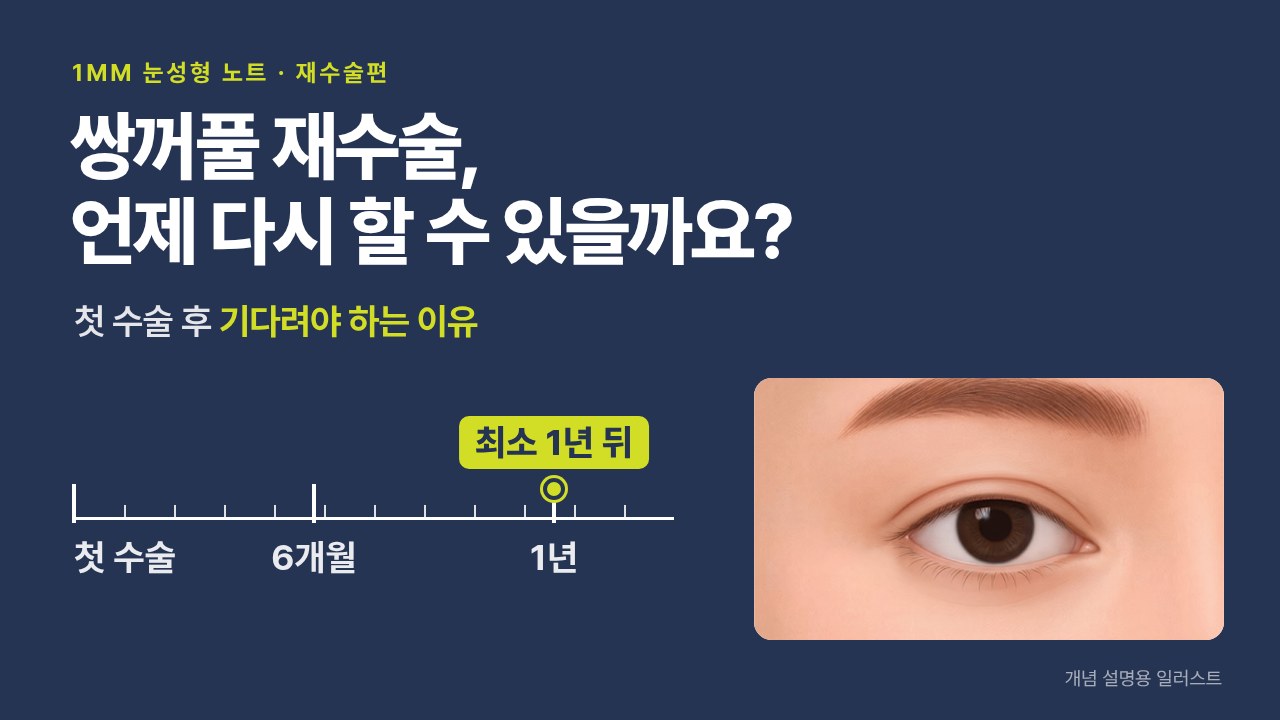
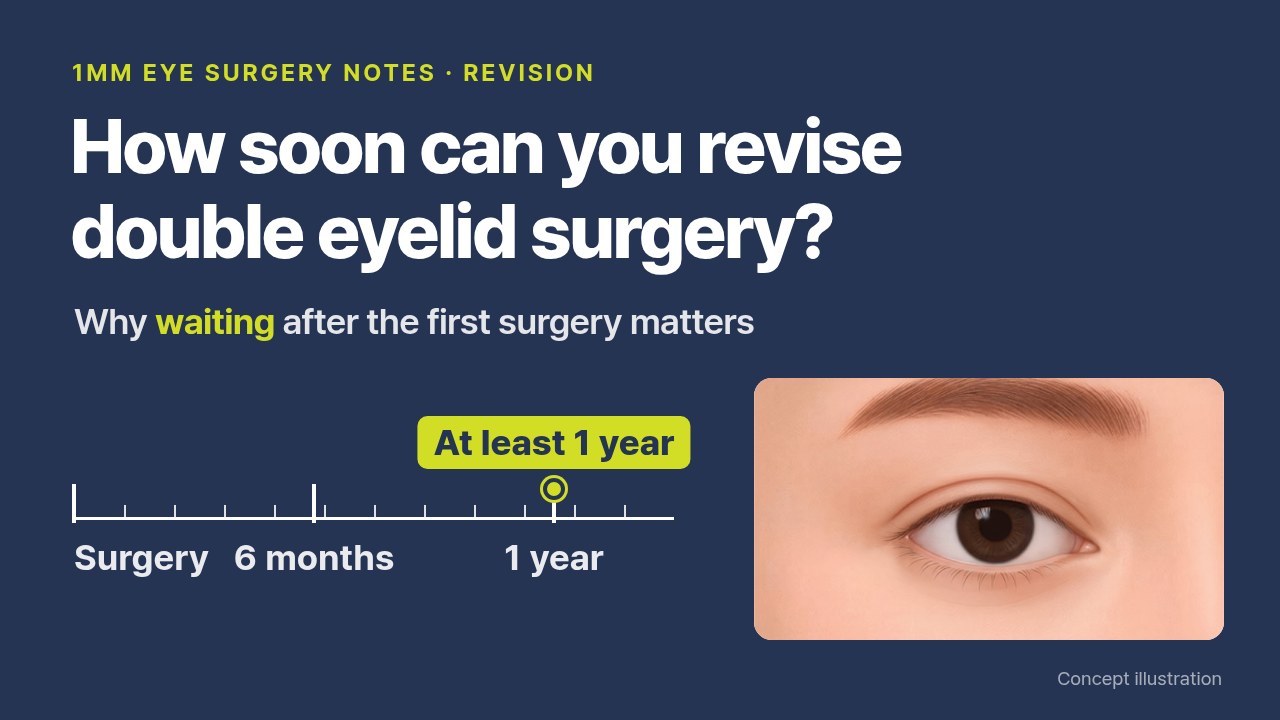
If you are unhappy with your crease after a first double eyelid surgery, you may want to have it redone as soon as possible. 1mm Plastic Surgery’s double eyelid revision guidance advises that it is best to have revision at least one year later. That is because an accurate diagnosis is only possible once the eyelid tissue has stabilized. Here we explain what keeps changing in your eyes while you wait, what you can do in the meantime, and when the exceptions apply.
Is the crease you see now after your first surgery the final result?
A common thought
It hasn’t been long since my surgery, but my crease looks far too thick. Can’t I just have it redone now?
If your crease bothers you every time you look in the mirror, it is natural to feel this way. However, in the early period after surgery, the crease can look different as swelling goes down and the tissue recovers.
After surgery, it takes time for scars to heal, swelling to go down and the tissue to settle. So it is hard to say for certain that the crease you see now, while you are still recovering, is the final result.
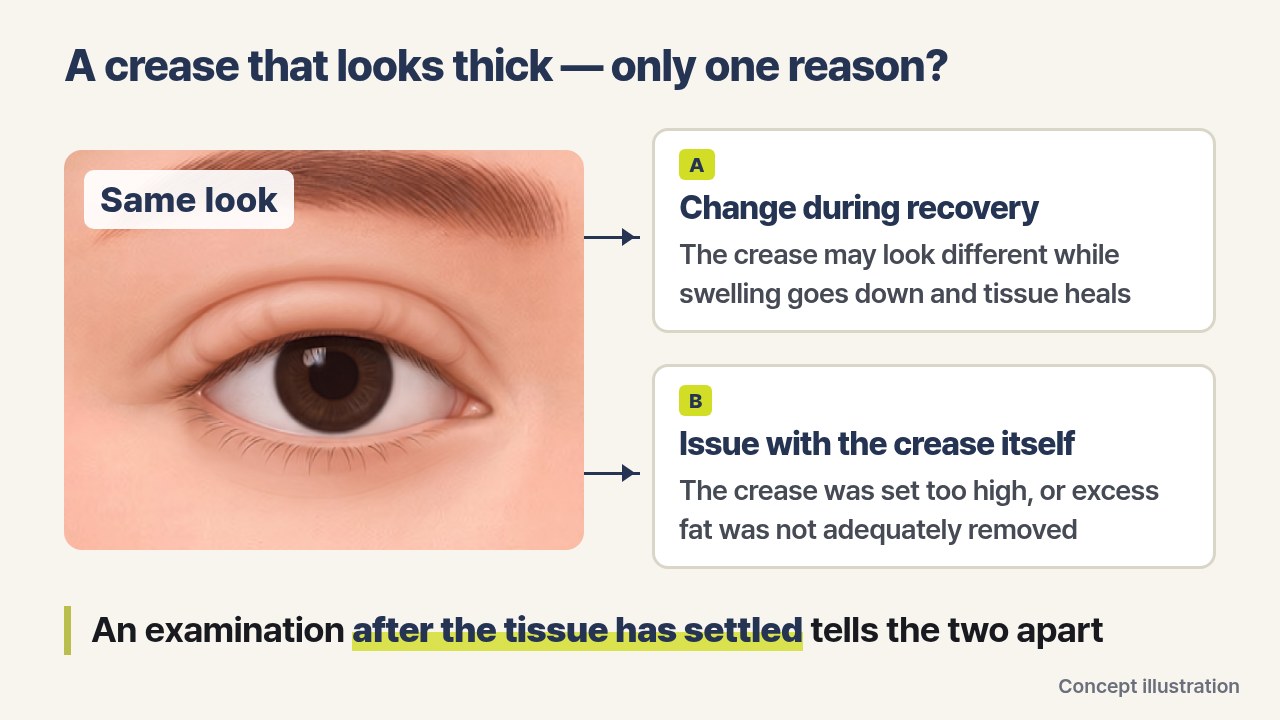
For example, if your crease looks thick, there are two possibilities to consider. One is that the crease temporarily looks different during recovery; the other is that the cause lies in the crease itself, for instance when the crease was set too high or excess fat was not adequately removed. Even if the two look similar, it is difficult to diagnose accurately which one it is before the tissue has stabilized.
This is the key point
If you are considering revision, you first need to tell whether the current change is temporary or a problem that actually needs correcting. That distinction becomes possible only once the tissue has stabilized.
Why are you told to wait at least a year for double eyelid revision?
1mm Plastic Surgery’s double eyelid revision guidance advises that it is best to have revision at least one year later. The reason comes down to one sentence: a diagnosis is only possible once the eyelid tissue has stabilized.
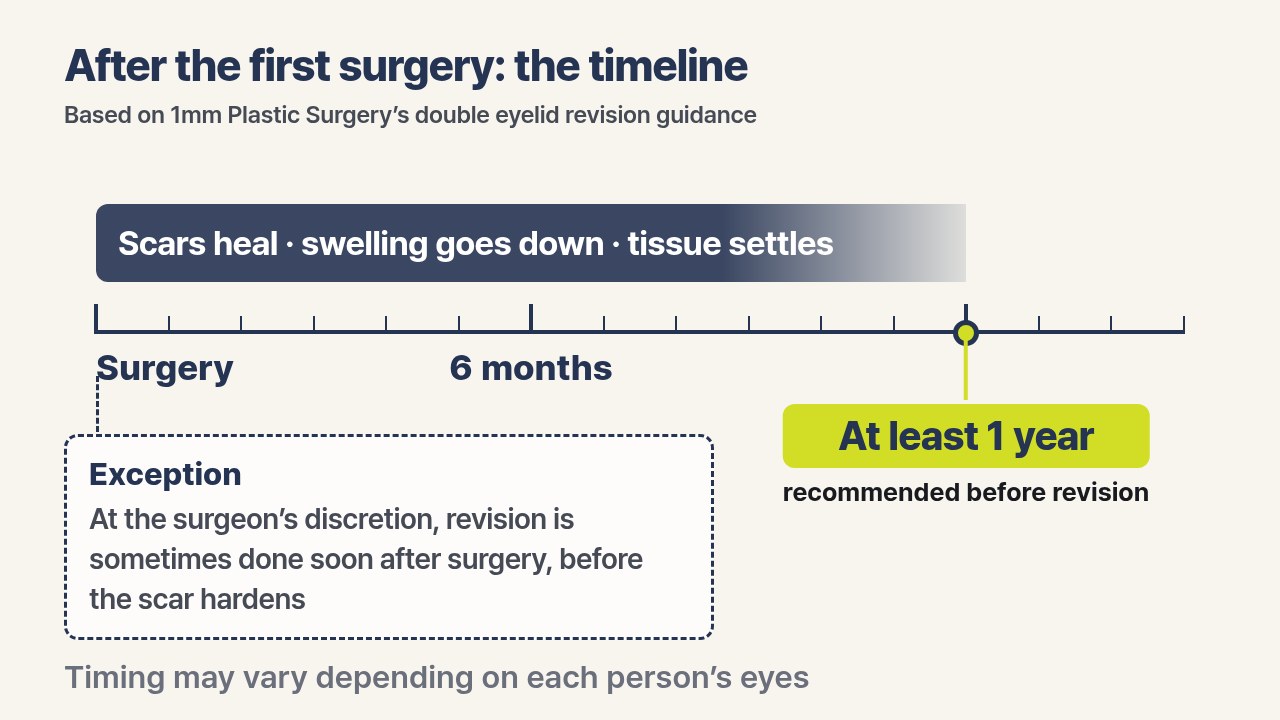
Along with the guideline of waiting at least one year, it helps to know the following.
- A crease still recovering — In the early period after surgery, the crease can look different as swelling goes down and the tissue recovers.
- An accurate diagnosis — Conditions such as the height and thickness of the crease, differences between left and right, and scarring and adhesion from the previous surgery can only be properly assessed once the tissue has stabilized.
- After the wait — Because revision surgery requires removing scar tissue from the previous surgery while minimizing tissue damage during the operation, the current state of the tissue is assessed first once it has stabilized, and then a plan is made.
Timing can differ from person to person
‘At least one year’ is a general guideline, and the actual timing may vary depending on the individual’s eyes.
What can you do while you wait?
There are things you can do during the waiting period: day-to-day care that supports recovery, and preparing for a future consultation. First, in the early recovery period, it is best to avoid the following.
- Rubbing your eyes hard
- Repeatedly pulling on your eyelids
For activities that can irritate the eyelids, such as washing your face, wearing makeup or wearing contact lenses, it is important to follow the recovery schedule your medical team gives you. Not every problem can be prevented through daily habits alone, but reducing unnecessary irritation and following the precautions you are given can help with a stable recovery.
Waiting does not mean ‘leaving it alone’
If you have pain that remains hard to bear even after taking painkillers, if your vision becomes blurrier as time passes, if your eyes do not close properly, or if you feel that your eye-opening strength has become weaker than before — or if you notice any other unusual change — it is best to tell the clinic where you had surgery right away and be seen, no matter how long it has been since surgery.
Noting down the following while you wait can help when you have a consultation later.
- The date and method of your first surgery — when it was done, and whether the incisional or the suture method was used. This can be a useful reference when planning revision.
- What concerns you most right now — crease height, thickness, shape or the difference between left and right
- How you would like it to look — the crease and eye shape you want
Is revision ever done earlier than one year?
Yes. 1mm Plastic Surgery’s guidance also notes that at the surgeon’s discretion, revision is sometimes done soon after surgery, before the scar hardens. Whether this applies is decided by the surgeon who has examined your eyes in person.
Conversely, passing the one-year mark does not mean everyone needs revision. There are two main reasons people consider revision: a result that differs from the crease or shape they wanted (dissatisfaction), and side effects caused by inflammation or infection after surgery. Even after the waiting period, the first thing to check is why the crease turned out the way it did — in other words, the cause.
The six situations that call for revision — such as a thick crease, asymmetry, a loosened crease, multiple creases and scarring — and how each cause is approached are covered in “Double Eyelid Revision: What to Know Before Going Back — Six Causes and the Right Timing”.
More than the date: whether a diagnosis is possible
The generally recommended timing is at least one year, but what matters more than the date itself is whether the tissue has stabilized enough for a diagnosis.
What is diagnosed once the tissue has stabilized?
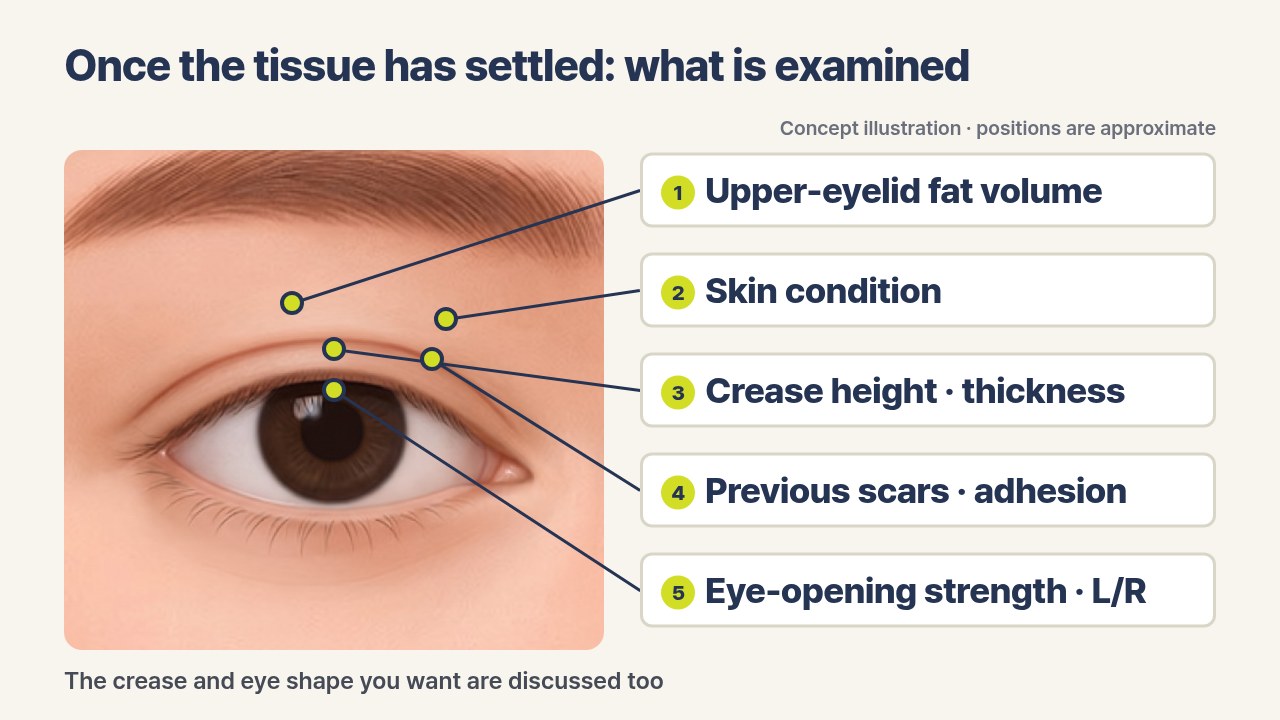
Once the tissue has stabilized, the problems from the previous surgery and the current state of your eyes can be checked. Rather than simply redrawing the visible crease, revision should look at both function and appearance. The table below summarizes what is checked in the examination and which concerns each item relates to.
| What is checked | Related concern |
|---|---|
| Crease height and thickness | A thick “sausage eyelid” crease may occur when the crease was set too high or excess fat was not adequately removed. |
| Upper-eyelid fat volume | Remaining fat calls for a different approach from the opposite case, where too much fat, muscle or other tissue was removed and multiple creases formed. |
| Eye-opening strength and left–right difference | Asymmetry may arise because differences in the size or height of the two eyes were not fully taken into account in the previous surgery, or because the strength of the eye-opening muscle differs between sides. |
| Scarring and adhesion from the previous surgery | Revision requires removing scar tissue from the previous surgery while minimizing tissue damage during the operation. |
| Current skin condition | Depending on adhesion, scarring, skin condition and so on, the incisional method may be needed. |
The actual cause is confirmed through examination, and even the same concern may call for a different approach depending on the cause.
The cases and approaches for double eyelid revision at 1mm Plastic Surgery are described on the double eyelid revision page of our website.
About side effects
Results and recovery after double eyelid revision can differ depending on your surgical history and the current state of your eyes, and side effects such as swelling and bruising, asymmetry, inflammation and infection, scarring and loosening of the crease can occur. Existing scars also cannot be removed entirely. It is best to plan revision with the size and location of the scar in mind, so that as little additional scarring as possible is left.
Double eyelid revision timing: frequently asked questions
How soon can I revise my double eyelids after surgery?
Right after a first surgery, the crease may still be recovering, so 1mm Plastic Surgery’s guidance advises that it is best to have revision at least one year later, once the tissue has stabilized and a diagnosis becomes possible. At the surgeon’s discretion, revision is sometimes done soon after surgery, before the scar hardens, and the timing may vary depending on the individual’s eyes.
It hasn’t been long since my surgery and my crease looks thick. Do I need revision?
In the early period after surgery, the crease can look different as swelling goes down and the tissue recovers, so it is hard to say for certain from how it looks now that revision is needed. Whether it is a temporary change or a problem with the crease itself is determined by examination once the tissue has stabilized.
Is revision ever done earlier than one year?
Yes. At the surgeon’s discretion, revision is sometimes done soon after surgery, before the scar hardens. Whether this applies is decided after examining your eyes in person.
Once a year has passed, can I go straight ahead with revision?
Passing the time mark does not mean everyone needs revision. What bothers you now, what the specialist sees as the problem and how you want it improved are checked together in the consultation, and the surgical plan is discussed once the cause has been identified.
How should I care for my eyes while I wait?
In the early recovery period, it is best to avoid rubbing your eyes hard or repeatedly pulling on your eyelids, and to follow the recovery schedule your medical team gives you for things such as washing your face, wearing makeup or wearing contact lenses. If you notice anything unusual — such as pain that is hard to bear, vision that keeps getting blurrier or eyes that do not close properly — tell the clinic where you had surgery right away, no matter how long it has been since surgery.
What happens in a consultation
Before setting a date,
we check the current state of your eyes
- Care from a plastic surgery specialist
- Checking when and how the previous surgery was done
- Checking the current state of your eyes and any problems
- Discussing how you want it improved
We look at what bothers you now and how you want it improved, and discuss a surgical plan together. Results and recovery may differ from person to person.
Consultation and booking
| Enquiries |
[email protected]
Getting in touch in advance can help reduce your waiting time. |
|---|---|
| Telephone | +82-2-552-1171 |
| +82 10-9451-1171 | |
| Opening hours |
Weekdays 10:00 – 19:00 Saturday 10:00 – 16:00 Closed Sundays and public holidays — for holiday opening, please check the monthly schedule notice. |
| Address | 7th, 8th, 9th and 10th floors, Youngshin Building, 449 Gangnam-daero, Seocho-gu, Seoul
In front of Sinnonhyeon Station Exit 7, a 2-minute walk |
| Website | 1mmpsglobal.com |
#DoubleEyelidRevision #RevisionTiming #EyeRevision #DoubleEyelidSurgery #DoubleEyelidRecovery #EyelidSwelling #EyeSurgery #GangnamPlasticSurgery #1mmPlasticSurgery #1mmps
This post was written by the founder of a medical institution to provide medical information. The eye images in this post are concept illustrations created to aid understanding; they do not show real people or before-and-after results. The interior images are those published in the ‘Clinic Tour’ section of the 1mm Plastic Surgery website and may differ from the actual space. For any surgery, its suitability for you, the result and the course of recovery may differ depending on your eye condition and surgical history, and side effects may occur. Please confirm the details through a consultation.
Clinic Info
Details
- 서울특별시 서초구 강남대로 449 영신빌딩 7, 8, 9, 10층
- 02-552-1171
- Mon-Fri 10:00-19:00Sat 10:00-16:00
- Director 도언록
- 1mmps.com