2026-10-18
Double Eyelid Revision: What to Know Before Going Back — Six Causes and the Right Timing
Double eyelid revision starts with understanding why the previous crease turned out that way. This guide covers six common causes, how each is improved, and when to revise.
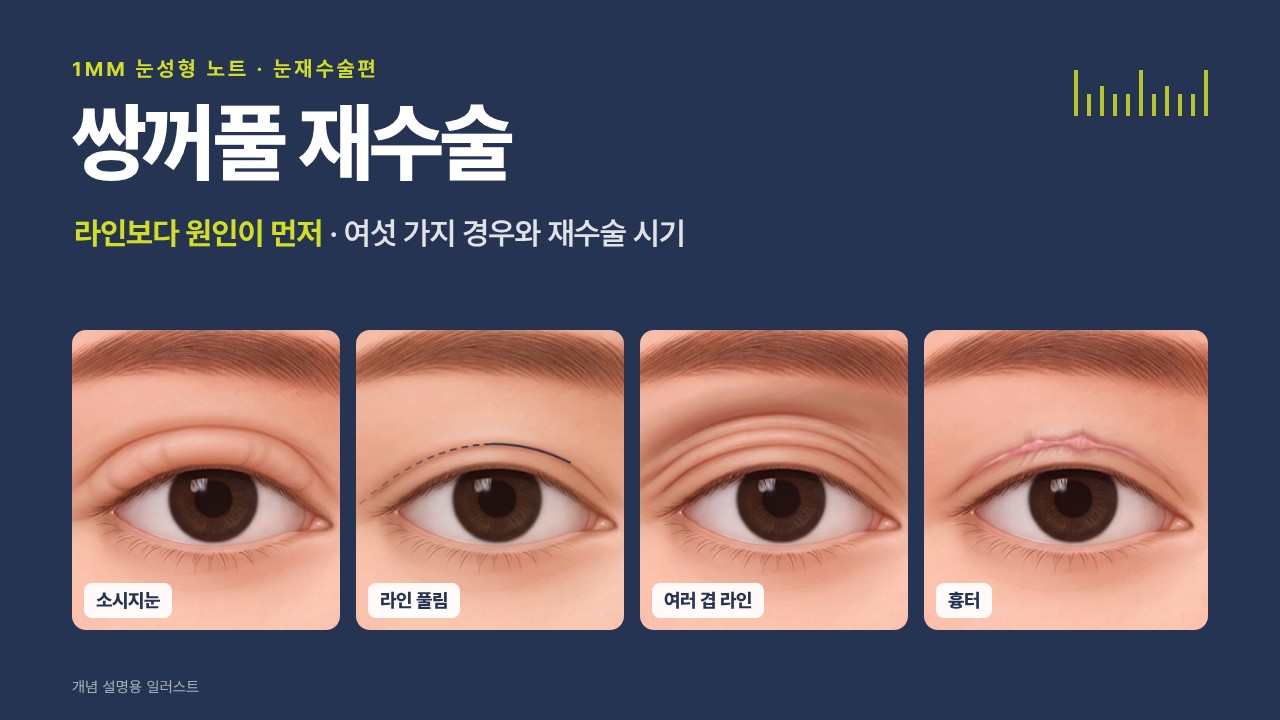
The double eyelid revision guide from 1mm Plastic Surgery divides the cases that require revision into six categories. From overly thick “sausage eyes” and asymmetry to loosened creases, multiple creases, and visible scarring, the right approach depends on the cause. That's why the starting point is identifying what went wrong with the previous surgery. Below, we cover the six cases and how each is improved, the right timing for revision, and what to discuss during your consultation.
What should you look at first in double eyelid revision?
[Commonly heard at consultations]The crease is too thick. Can it be made thinner?The crease seems to have loosened. Can it be secured again?It hasn't been long since my surgery. When can I have it redone?
There are two main reasons people consider double eyelid revision:
- Dissatisfaction — results that differ from the crease or shape you had hoped for
- Complications — problems caused by inflammation or infection after surgery
Revision means operating on an eyelid that has already been treated, so it requires removing the scar tissue left from the previous procedure and minimizing further tissue damage during surgery. If you've had double eyelid surgery before, an incision method may be needed depending on current adhesions, scarring, and skin condition.
That's why, in revision, it's best to first check why the current crease turned out this way rather than asking, “What crease should I get?”
Six cases that call for revision and how to improve them
Even though they're all called “revision,” the approach depends on the cause.
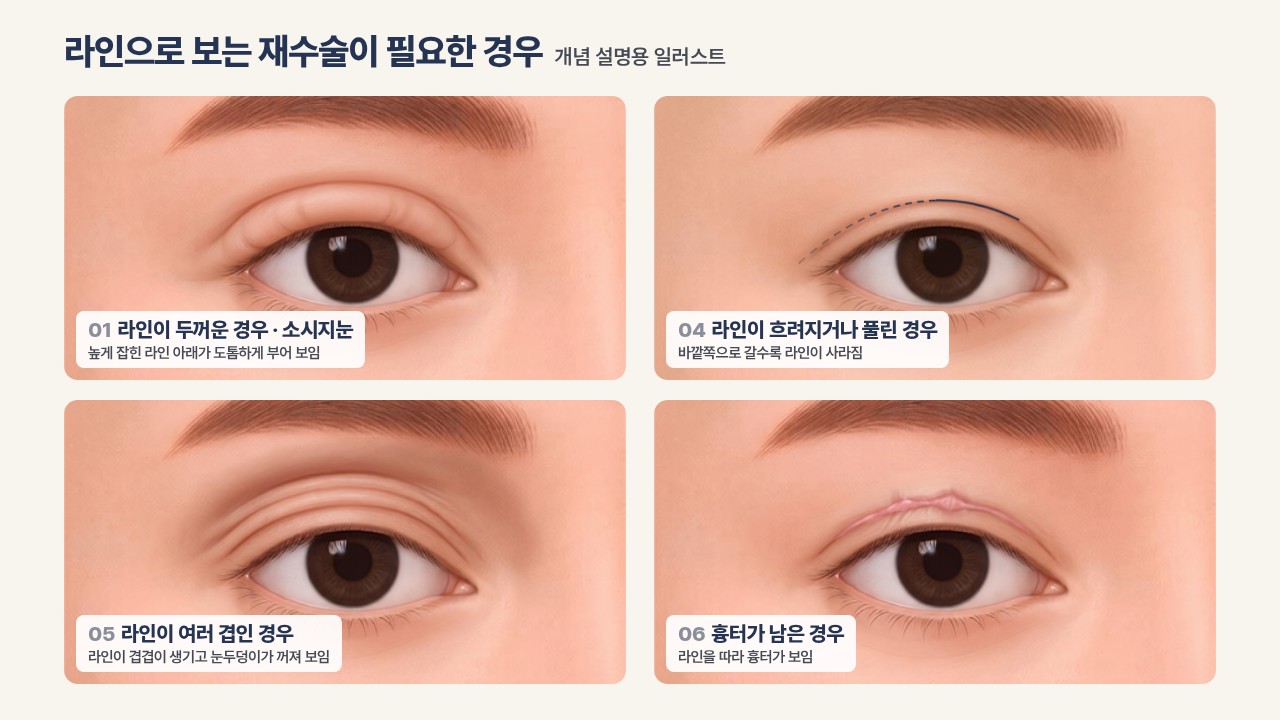
Revision 01 / 06 · Thick crease (sausage eyes)
This happens when the crease is set too high or when excess fat hasn't been sufficiently removed. Depending on the cause, the plan is to remove fat or adjust the crease height to create a natural-looking line.
Revision 02 / 06 · Left-right asymmetry (mismatched eyes)
This occurs when the size or height difference between the eyes wasn't adequately factored into the surgical plan, or when the strength of the eye-opening muscles differs between the two sides. The plan is to adjust the crease thickness to match the two eyes as closely as possible.
Revision 03 / 06 · Dissatisfaction with the crease shape (crease design)
This dissatisfaction arises when the desired crease wasn't adequately communicated during the previous surgery. The procedure moves forward only after you and your surgeon confirm the desired crease through thorough discussion.
Revision 04 / 06 · Faded or loosened crease (crease loosening)
Weak crease fixation has caused the crease to loosen. The focus is on redesigning the crease and securing it so it won't loosen again.
Revision 05 / 06 · Multiple creases (layered creases)
Excessive removal of fat or tissue from the eyelid area has caused layered creases to form. The approach is to restore volume to the eyelid or fix the crease into a single line.
Revision 06 / 06 · Noticeable scarring (scar)
Scarring stands out due to issues during suturing or because of scar tissue. Correction is tailored to the specific condition, including whether scar tissue needs to be removed.
This is the key point
Revision needs to address both functional and aesthetic concerns. Rather than simply redrawing the visible crease, it's important to first accurately identify the specific condition and problem that requires revision.
Are mismatched eyes caused by the crease or by eye-opening strength?
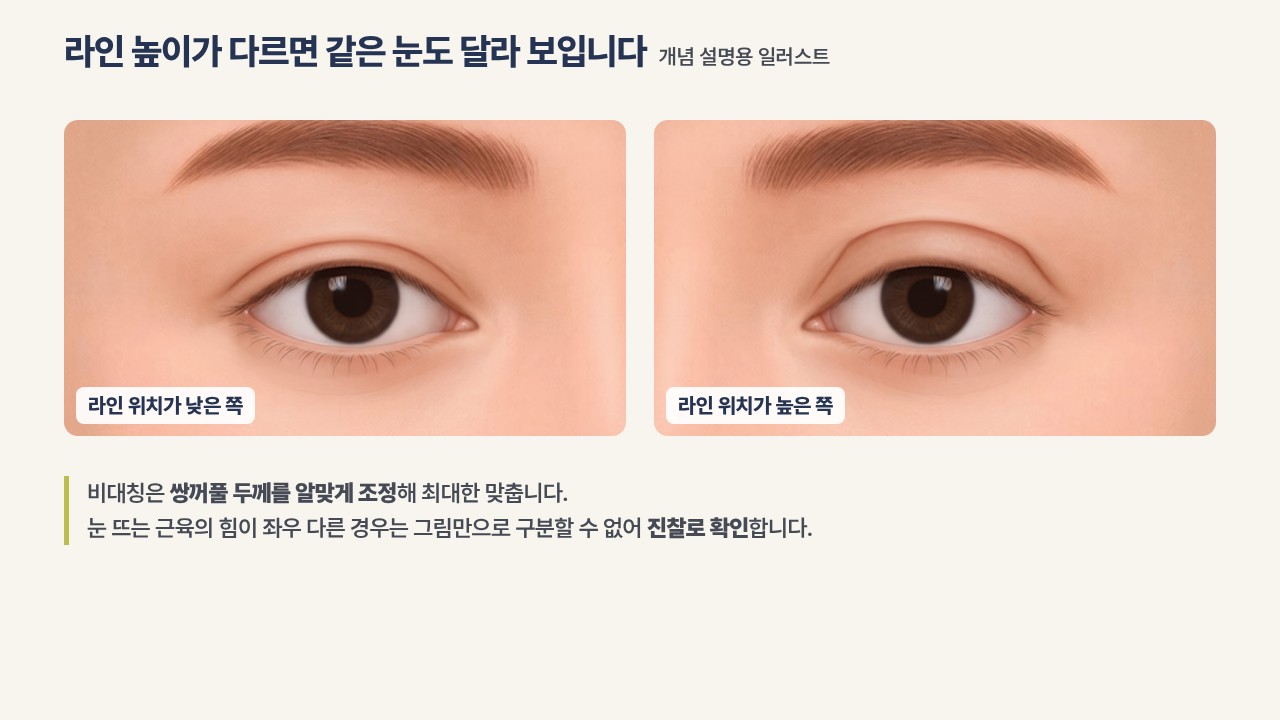
Uneven eyes are one of the most common reasons people consider revision. However, even when two eyes look equally “mismatched” from the outside, the underlying cause can differ.
| Cause of asymmetry | What we check |
|---|---|
| Size or height difference between the eyes wasn't adequately accounted for | The crease thickness is adjusted to correct the asymmetry as much as possible |
| Eye-opening muscle strength differs between the two sides | Along with crease thickness adjustment, eye-opening strength is also evaluated |
What we examine depends on the cause of the asymmetry. The actual cause is determined through examination.
Double eyelid surgery addresses the crease, while eye-shape correction addresses eye-opening strength. So mismatched eyes aren't all corrected the same way; the scope of surgery needed can vary depending on where the cause lies.
When can you have revision surgery?
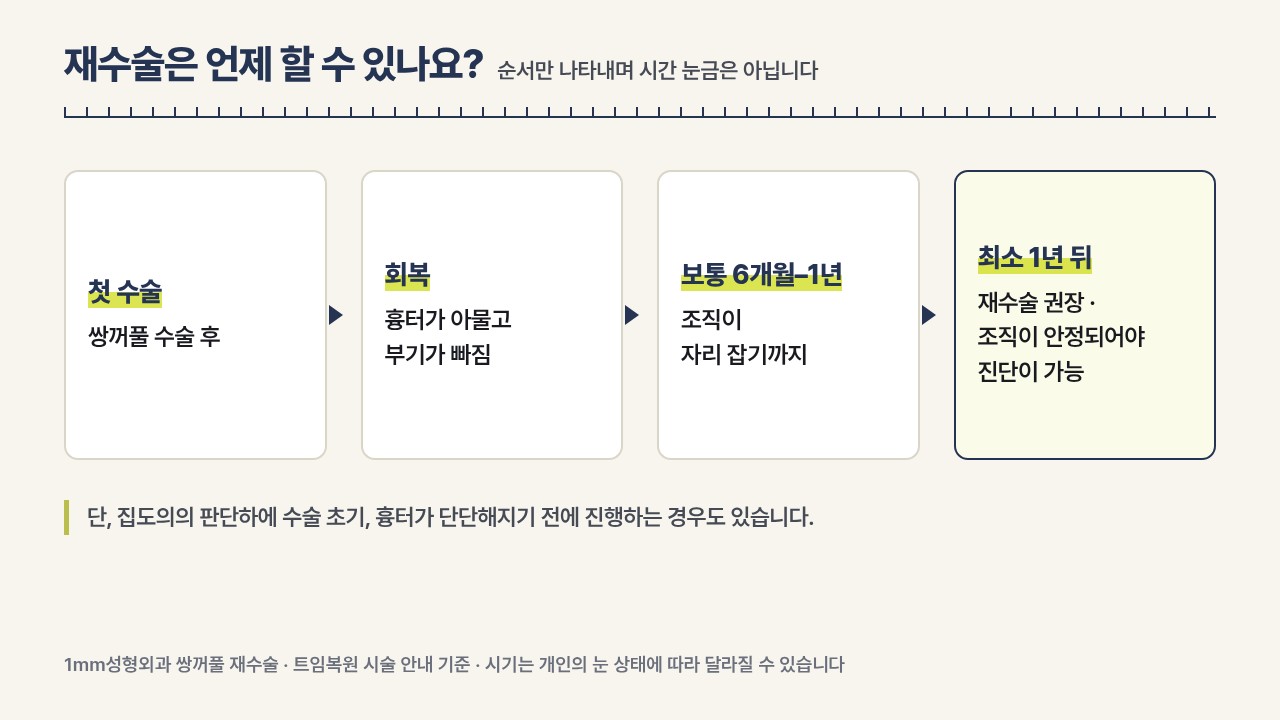
After eye surgery, it typically takes about 6 months to 1 year for the scar to heal, swelling to go down, and the results to settle. For that reason, double eyelid revision is best done at least one year after the initial surgery, since an accurate diagnosis requires the eye tissue to be stable.
That said, at the operating surgeon's discretion, revision may sometimes be performed early, before the scar tissue has hardened.
Stability first, not rushing
An accurate diagnosis requires stable eye tissue. Rather than rushing into revision, it's better to allow time for the tissue to settle and to monitor progress together with your doctor.
What to discuss during your consultation
The more involved the revision, the more important open communication between patient and medical team becomes. Before surgery, we carefully review the points below and then discuss the surgical plan.
- Current concerns — which aspect bothers you most: crease height, thickness, shape, or left-right difference
- Issues from the specialist's perspective — post-surgery conditions such as adhesions, scarring, fat volume, and eye-opening strength
- Desired outcome — the crease and eye shape you're hoping for
If you know when and how your previous surgery was performed (incision or non-incision method), please share it during your consultation. It can help inform the revision plan.
What happens to the scar?
Existing scars cannot be completely erased. However, considering the size and location of the scar, revision should be planned to avoid leaving any additional visible scarring as much as possible.
In summary, the cause comes before the crease
In double eyelid revision, the priority is understanding why the current crease turned out this way, rather than simply choosing a new one. Even similar concerns can call for different solutions depending on the cause, and the results you can expect may vary from person to person.
In particular, the following factors should be reviewed together:
- Crease height and thickness
- Amount of fat in the eyelid area
- Left-right difference in eye-opening strength
- Adhesions and scarring from previous surgery
- Current skin condition
- Desired crease and eye shape
To sum up
If you have a specific crease in mind, share it fully during your consultation. However, it's important to first confirm the problems from your previous surgery and the current condition of your eyes through a plastic surgeon's evaluation, and then decide on the revision method by weighing both aesthetic and functional aspects.
Frequently asked questions
When can I have double eyelid revision?
It's best to wait at least one year. After eye surgery, it typically takes about 6 months to 1 year for the scar to heal, swelling to subside, and the results to settle, and an accurate diagnosis requires stable eye tissue. However, at the operating surgeon's discretion, revision may sometimes be performed early, before the scar hardens.
Can sausage eyes with a very thick crease be improved with revision?
Thick sausage-like creases can result from setting the crease too high or from not removing enough excess fat. Depending on the cause, revision is planned to remove fat or adjust the crease height to create a natural-looking line. How much improvement you see depends on the current condition of your eyelids.
Do all mismatched eyes need eye-shape correction?
Not necessarily. Asymmetry can come from differences in crease height or thickness, or from differences in the strength of the eye-opening muscles between the two sides. Double eyelid surgery addresses the crease, while eye-shape correction addresses eye-opening strength, so the scope of surgery needed depends on where the cause lies.
Can a loosened crease be fixed again?
When a crease has faded or loosened due to weak fixation, the focus is on redesigning the crease and securing it so it doesn't loosen again. Depending on adhesions or scarring from the previous surgery, skin condition, and other factors, an incision method may sometimes be needed.
Will revision remove existing scars?
Existing scars cannot be completely eliminated. However, considering the size and location of the scar, revision should be planned to avoid leaving any additional visible scarring as much as possible. If scar tissue needs to be removed, correction is tailored to the specific condition.
What We Do During Your Consultation
Through a plastic surgeon's evaluation,
we start by identifying the cause of your previous surgery
- Consultation with a plastic surgery specialist
- Personalized 1:1 plan tailored to your features
- Thorough cause analysis through open communication
- Disinfection and sterilization to prevent infection
We review your current concerns and desired outcome together and discuss the surgical plan.
Consultation and booking information
| Consultation / Booking | global@1mmps.com Contacting us in advance can help reduce your waiting time. |
|---|---|
| KakaoTalk | @일미리성형외과의원 |
| Clinic hours | Weekdays 10:00 AM – 7:00 PM Saturdays 10:00 AM – 4:00 PM Closed on Sundays and public holidays. Please check the monthly schedule announcement for holiday availability. |
| Location | 7th–10th Floor, Youngsin Building, 449 Gangnam-daero, Seocho-gu, Seoul |
| Website | 1mmpsglobal.com |
#DoubleEyelidRevision #EyeRevisionSurgery #SausageEyes #SausageEyeRevision #AsymmetricEyes #UnevenDoubleEyelids #LooseCrease #MultipleCreases #DoubleEyelidScar #RevisionTiming #EyelidSurgery #DoubleEyelidSurgery #GangnamStationPlasticSurgery #1mmPlasticSurgery #일미리성형외과
This post was prepared by the operator of the medical institution for the purpose of providing medical information. Procedure information is based on the double eyelid revision and eye-corner restoration guide page of 1mm Plastic Surgery. The eye illustrations in this article are for illustrative purposes only and are not actual patient photos or before-and-after images. Every procedure's applicability, results, and recovery may vary depending on individual eye condition and previous surgical history, and side effects may occur. Please confirm the details during a consultation.
Clinic Info
Details
- 서울특별시 서초구 강남대로 449 영신빌딩 7, 8, 9, 10층
- 02-552-1171
- Mon-Fri 10:00-19:00Sat 10:00-16:00
- Director 도언록
- 1mmps.com