2026-11-03
Under-Eye Fat Repositioning vs Eye Bag Removal (and Lower Blepharoplasty): Which One Fits Your Under-Eyes?
Under-eye fat repositioning and removal differ in whether fat is reduced or moved into the hollow. How to read puffiness, hollow grooves and loose skin.
Both procedures usually treat puffy under-eye fat through the conjunctiva on the inside of the lower eyelid. The difference is whether the fat is simply reduced, or spread out and moved into the hollow below. The first thing that sets the direction is whether you have puffiness alone, or puffiness with a hollow groove underneath.
Why do under-eyes look puffy?
Under-eye fat is a normal tissue that supports the eyeball from below. When this fat looks pushed forward, the under-eye becomes puffy and a shadow tends to form beneath it.
A common thought
It’s fat that sticks out — can’t it just be taken out?
The reasons the fat becomes puffy are generally explained in two ways.
- Natural amount of fat — some people are born with a larger amount of under-eye fat.
- A loosened septum — the membrane that holds the fat in place (the orbital septum) loosens, and the fat is pushed forward.
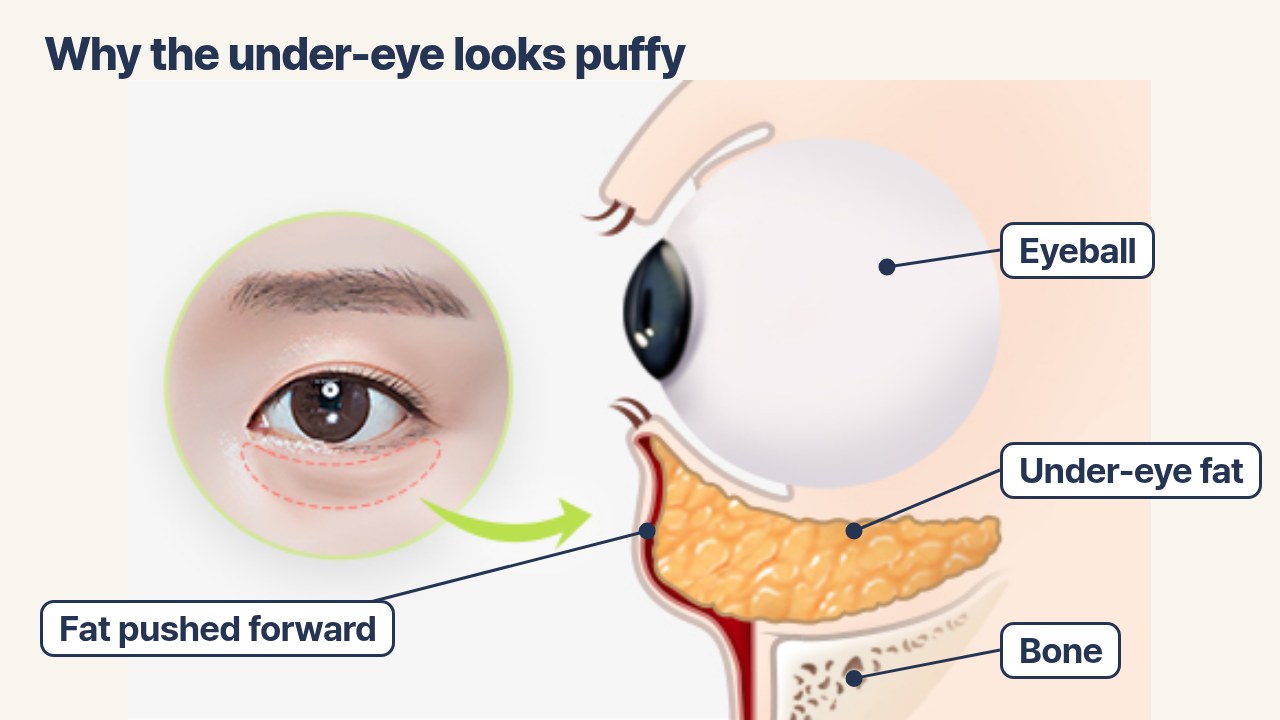
When looking at the under-eye, two more things are checked besides puffiness: whether the area just below the puffiness has sunk into a groove (the tear trough), and whether the under-eye skin has loosened and formed wrinkles. Which of these three you have changes which surgery is discussed.
Under-eye fat repositioning vs fat removal: what is the difference?
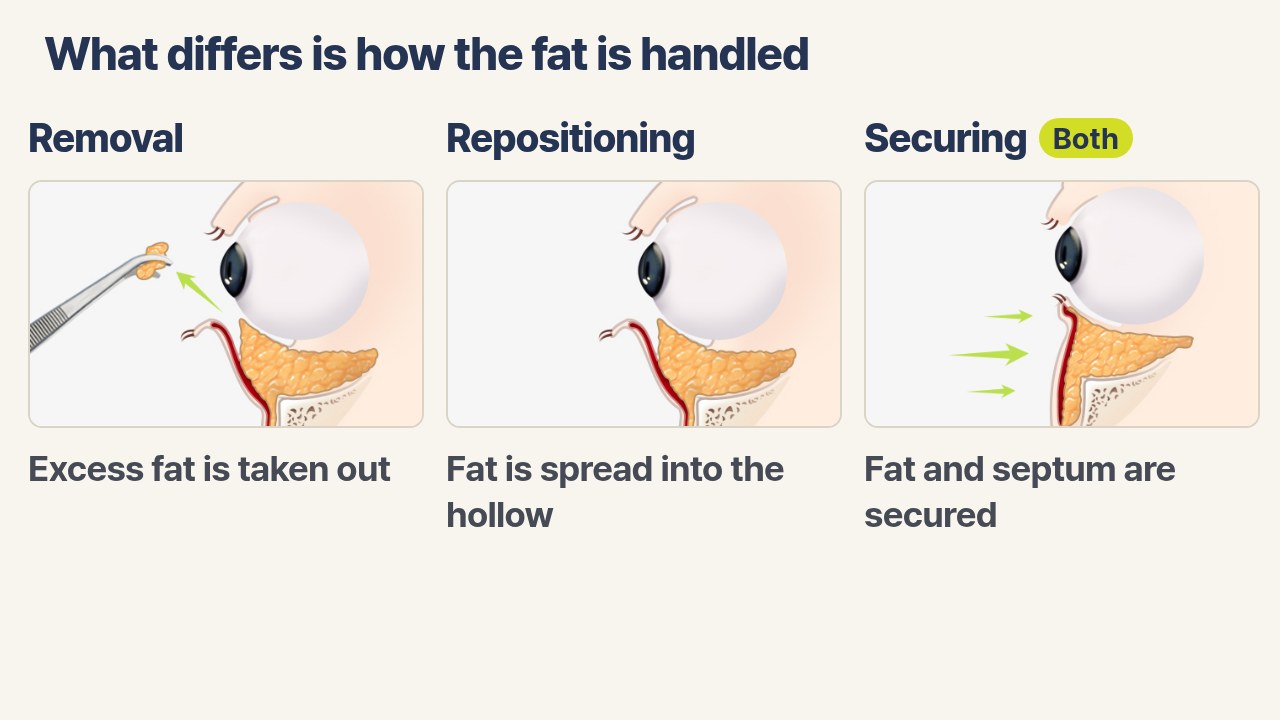
According to the 1mm Plastic Surgery website, both procedures reach the fat through a small incision in the conjunctiva on the inside of the lower eyelid. The skin surface is not incised. What differs is how the fat is handled.
- Under-eye fat removal (often called eye bag removal) — an appropriate amount of the excessively protruding fat is removed, and the fat pocket is pulled and secured to leave a flatter under-eye.
- Under-eye fat repositioning — the puffy fat is spread out, moved into the hollow area that needs volume (the tear trough) and secured. Some unnecessary fat may also be removed.
| Item | Fat removal | Fat repositioning |
|---|---|---|
| Approach | Small incision in the conjunctiva inside the eyelid | Small incision in the conjunctiva inside the eyelid |
| Fat handling | An appropriate amount of protruding fat is removed | Puffy fat is spread out and moved into the hollow (may include some removal) |
| Securing | The fat pocket is pulled and the orbital septum is secured | The moved fat is spread evenly, then secured |
| Usually discussed for | Marked puffiness without a hollow area | Puffiness together with a hollow groove, or an uneven under-eye |
| Aim | A generally flatter under-eye by reducing the protruding area | Smoothing the bulge and filling the groove to reduce the height difference |
| To consider | Because fat is taken away, it does not fill a hollow groove | If the fat is not repositioned evenly, the surface may look uneven |
Summarised from the under-eye surgery information on the 1mm Plastic Surgery website. With either procedure the area may become puffy again over time, and the actual method is decided in a consultation after examining your under-eyes.
Which one is closer to your under-eyes?
Looking at your under-eyes in a mirror, you can check which of the four patterns below they are closest to. This is only a reference for organising your concerns before a consultation — it is not a basis for choosing a surgical method yourself.
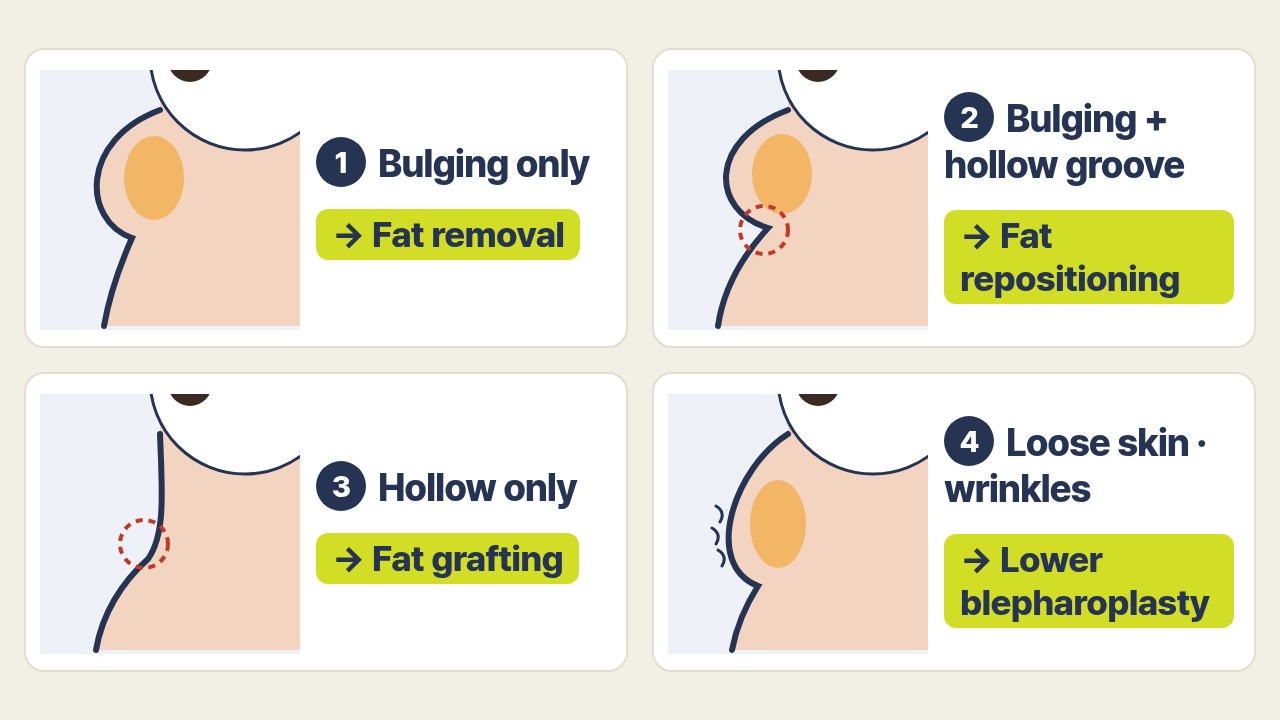
- Puffiness only — fat sticks out and casts a shadow, but there is no clear hollow beneath it. The website describes this as a case for under-eye fat removal.
- A hollow groove below the puffiness — bulging and hollow areas sit together so the under-eye looks uneven, or the shadow makes it look dark like dark circles. Under-eye fat repositioning is usually discussed.
- Hollowness only — the under-eye is sunken or flat with no puffy area. As there is no clear fat to reduce, the website describes under-eye fat grafting, which adds micro-fat.
- Loose skin and wrinkles — the skin may need to be treated together with the fat, so lower blepharoplasty is also considered. However, if the under-eye looks saggy mainly because of fat, repositioning or removal through the conjunctiva may also be discussed, so the degree of skin sagging is assessed together at the consultation.
In short
The direction of under-eye surgery comes down to whether fat is reduced, moved or added, and whether the skin is treated as well. In some cases two or more are combined, and the exact surgical method is decided after a consultation.
If the skin is loose, should you look at lower blepharoplasty?
Repositioning and removal through the conjunctiva do not cut away skin. So if the under-eye skin is very loose and wrinkles are the main concern, conjunctival surgery alone may not be enough to address them.
Lower blepharoplasty is a method in which an incision is made just below the lashes, the loose skin is removed, and in the same surgery the under-eye fat is removed or repositioned. The Rejuvenation Eyelid Surgery page of the 1mm Plastic Surgery website describes it as surgery that corrects sagging skin, wrinkles around the eyes and under-eye fat together.
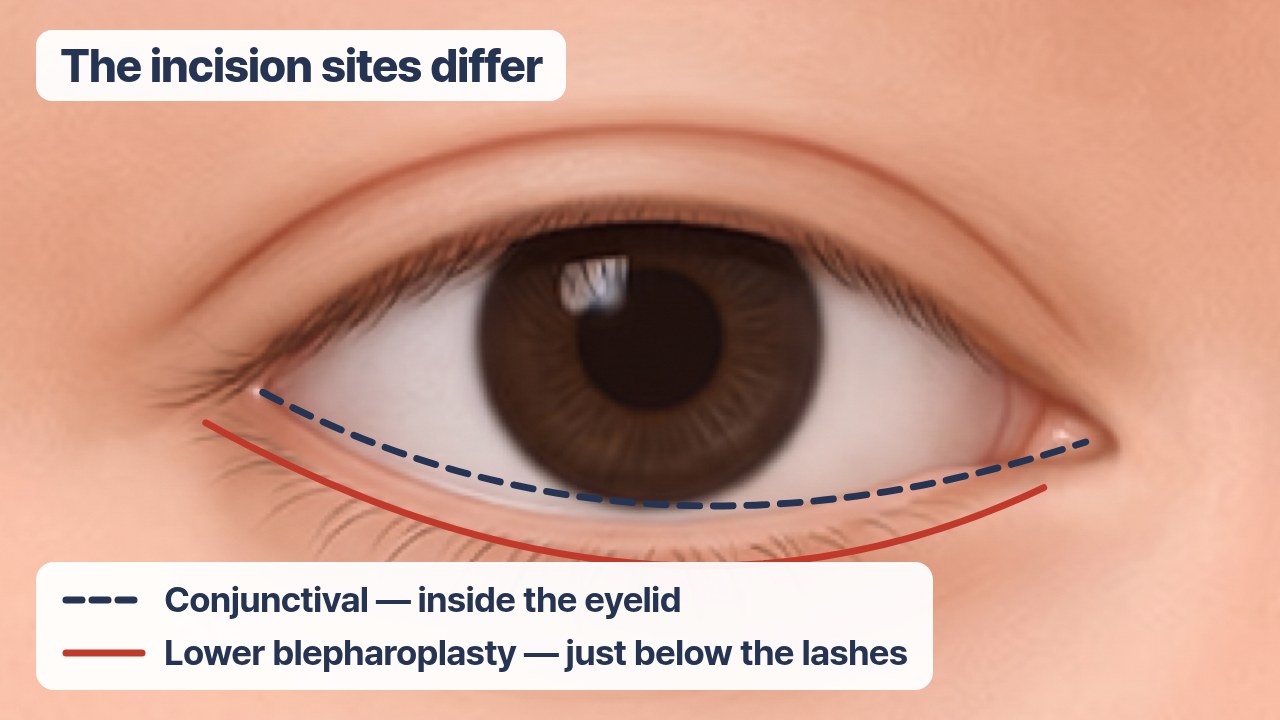
- Incision site — surgery through the conjunctiva is done on the inside of the eyelid; lower blepharoplasty uses an incision in the skin just below the lashes.
- Skin removal — surgery through the conjunctiva does not remove skin; lower blepharoplasty removes loose skin.
- Fat — with either method, under-eye fat can be removed or repositioned.
- Usually discussed for — if fat is the main concern, surgery through the conjunctiva is considered; if loose under-eye skin and wrinkles are also present, lower blepharoplasty is considered.
What are recovery and side effects like?
Whether it is surgery through the conjunctiva or lower blepharoplasty, it treats the area around the eye, so side effects may occur. The recovery period differs depending on your condition and the extent of the surgery.
Side effects to know about
- Swelling and bruising — the area around the eyes may swell or bruise after surgery, and how long it takes to settle varies from person to person.
- Bleeding and inflammation — depending on your condition, bleeding or inflammation may occur.
- Unevenness — if the fat is not repositioned evenly, the under-eye surface may look uneven.
- Recurrence — even after surgery, the under-eye may become puffy again over time due to ageing and other factors.
- Eyelid turning outward (lower blepharoplasty) — if the skin or the muscle around the eye (orbicularis oculi) is removed excessively, or a haematoma forms after surgery, among other causes, the lower eyelid may be pulled down and look turned outward.
If you notice anything unusual after surgery, tell the clinic that performed it right away. Please tell us in advance, at the consultation, about any medication you take and any previous eye surgery.
Individual differences
Results and recovery differ depending on your under-eye condition and the surgical method.
What is checked in an under-eye surgery consultation?
Even with the same ‘puffy under-eyes’, the amount and position of fat, the depth of the groove and the condition of the skin differ from person to person. The consultation looks at the following together with you.
- Extent and shape of the fat — which area protrudes and by how much.
- Depth and shape of the tear trough — whether there is a hollow groove below the puffy area.
- Skin thickness and laxity — how loose the skin is and whether there are wrinkles.
- Surrounding muscle and bone structure — structures such as the muscle layer around the eye and the cheekbones are also checked.
- Aegyo-sal — please mention at the consultation if you want to keep your aegyo-sal (the soft fullness just under the lower lashes).
- How it is secured — you are told how the fat is secured after it is reduced or moved.
After fat is repositioned or removed, 1mm Plastic Surgery includes a step that secures the fat and the orbital septum together (septum reinforcement) to reduce the chance of recurrence. How long the result lasts still differs from person to person.
Explanations of each method are on the 1mm Plastic Surgery under-eye surgery page. For more on preserving aegyo-sal and septum reinforcement, see our earlier post on under-eye fat repositioning and preserving aegyo-sal.
Under-eye fat repositioning and removal: frequently asked questions
Can under-eye fat surgery improve dark circles?
Cases where the under-eye looks dark because of the shadow cast by protruding fat are what the consultation looks at. Whether the darkness comes from a fat shadow is checked during the examination, and results differ from person to person.
If only fat is removed, won’t the under-eye look hollow later?
The website describes under-eye fat removal for ‘marked puffiness without a hollow area’. If there is a hollow groove below the puffiness, repositioning — moving the fat into the hollow — is considered rather than only removing fat. Which one suits you is decided in the examination by looking at the amount of fat and the groove.
Can the under-eye become puffy again after surgery?
Yes. Even after surgery, the under-eye may become puffy again due to ageing and other factors. To reduce this possibility, 1mm Plastic Surgery also secures the fat and the orbital septum. How long the result lasts differs from person to person.
Can lower blepharoplasty and under-eye fat repositioning be done together?
Lower blepharoplasty removes loose skin and, in the same surgery, removes or repositions under-eye fat. If loose skin and protruding fat are both present, this approach may be considered, and the exact surgical method is decided after a consultation.
What happens in a consultation
Before the name of a surgery,
we look at the shape of your under-eyes together
- Checking the extent and shape of the fat
- Checking hollow grooves and loose skin
- Explaining the surgical method and how it is secured
- Explaining side effects and post-surgery precautions
We check your under-eye condition and discuss a suitable surgical direction. Results and recovery may differ from person to person.
Consultation and booking
| Enquiries |
[email protected]
Getting in touch in advance can help reduce your waiting time. |
|---|---|
| Telephone | +82-2-552-1171 |
| +82 10-9451-1171 | |
| Opening hours |
Weekdays 10:00 – 19:00 Saturday 10:00 – 16:00 Closed Sundays and public holidays — for holiday opening, please check the monthly schedule notice. |
| Address | 7th, 8th, 9th and 10th floors, Youngshin Building, 449 Gangnam-daero, Seocho-gu, Seoul
In front of Exit 7, Sinnonhyeon Station — a 2-minute walk |
| Website | 1mmpsglobal.com |
#UnderEyeFatRepositioning #EyeBagRemoval #UnderEyeFatRemoval #LowerBlepharoplasty #UnderEyeSurgery #TearTrough #UnderEyeFatGrafting #DarkCircles #KoreanPlasticSurgery #1mmPlasticSurgery #GangnamPlasticSurgery
This post was written by the founder of a medical institution to provide medical information. The cross-section images are surgical explanation illustrations from the under-eye surgery page of the 1mm Plastic Surgery website with labels added, and the eye illustration and contour diagram are explanatory images made to aid understanding; they do not show real people or before-and-after results. The interior image is from the ‘Clinic tour’ on the website and may differ from the actual premises. For any surgery, its suitability for you, the result and the course of recovery may differ depending on your under-eye condition, and side effects may occur. Please confirm the details through a consultation.
Clinic Info
Details
- 서울특별시 서초구 강남대로 449 영신빌딩 7, 8, 9, 10층
- 02-552-1171
- Mon-Fri 10:00-19:00Sat 10:00-16:00
- Director 도언록
- 1mmps.com