2026-11-18
Mini Facelift in Korea: Who Is a Candidate, and What Changes Can You Expect?
A mini facelift addresses lower-face sagging such as cheeks and jawline through a small incision. This post explains how to tell whether your sagging is within its range, and what changes you can expect.

When your cheeks start to drop and your jawline begins to blur, the question ‘Do I need a facelift?’ often follows. A mini facelift is surgery that addresses sagging in the lower face through a small incision, so some kinds of sagging fit its range while others call for comparing other options as well. Rather than your age, the first thing to look at is where the sagging is and how far it has progressed.
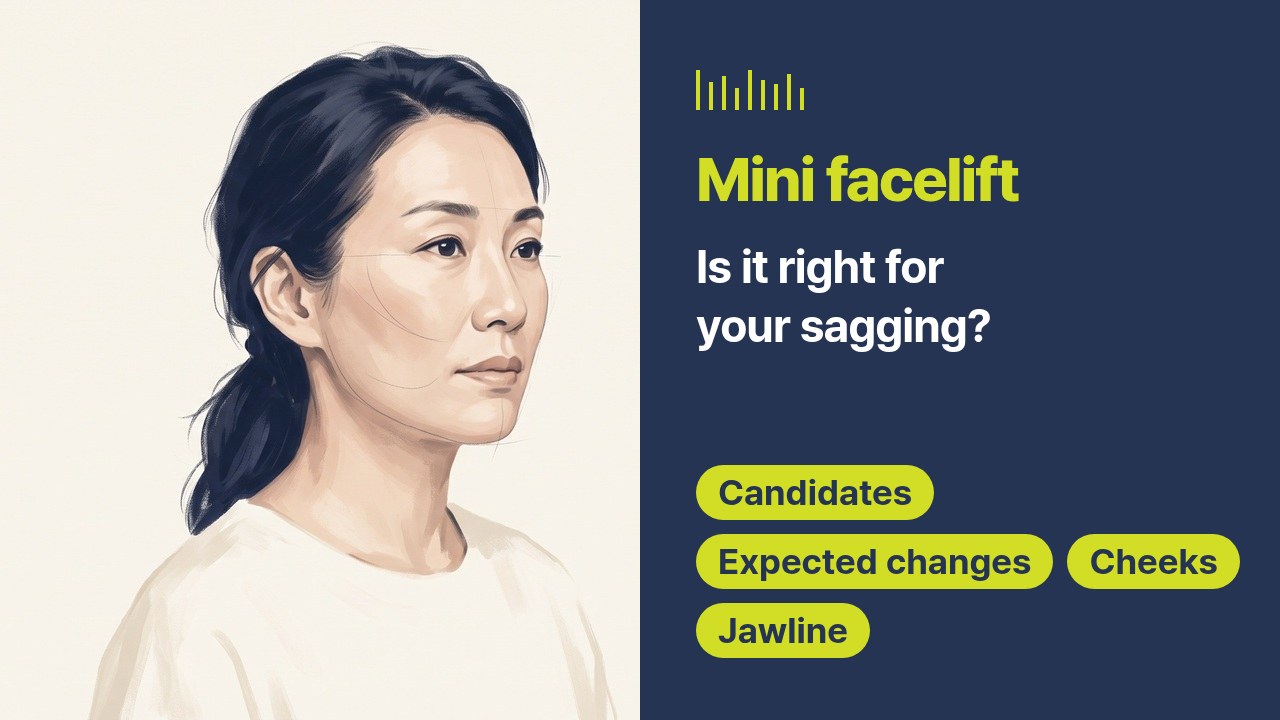
Which part of the face does a mini facelift address?
According to the 1mm Plastic Surgery website, a mini facelift is surgery in which an incision of about 2 cm is made inside the scalp near the sideburn, sagging tissue is lifted up to the layer beneath the skin called the SMAS, and the excess skin is trimmed. The incision lies inside the hair-bearing scalp, and its range is smaller than that of a facelift, whose incision extends to the line in front of the ear.
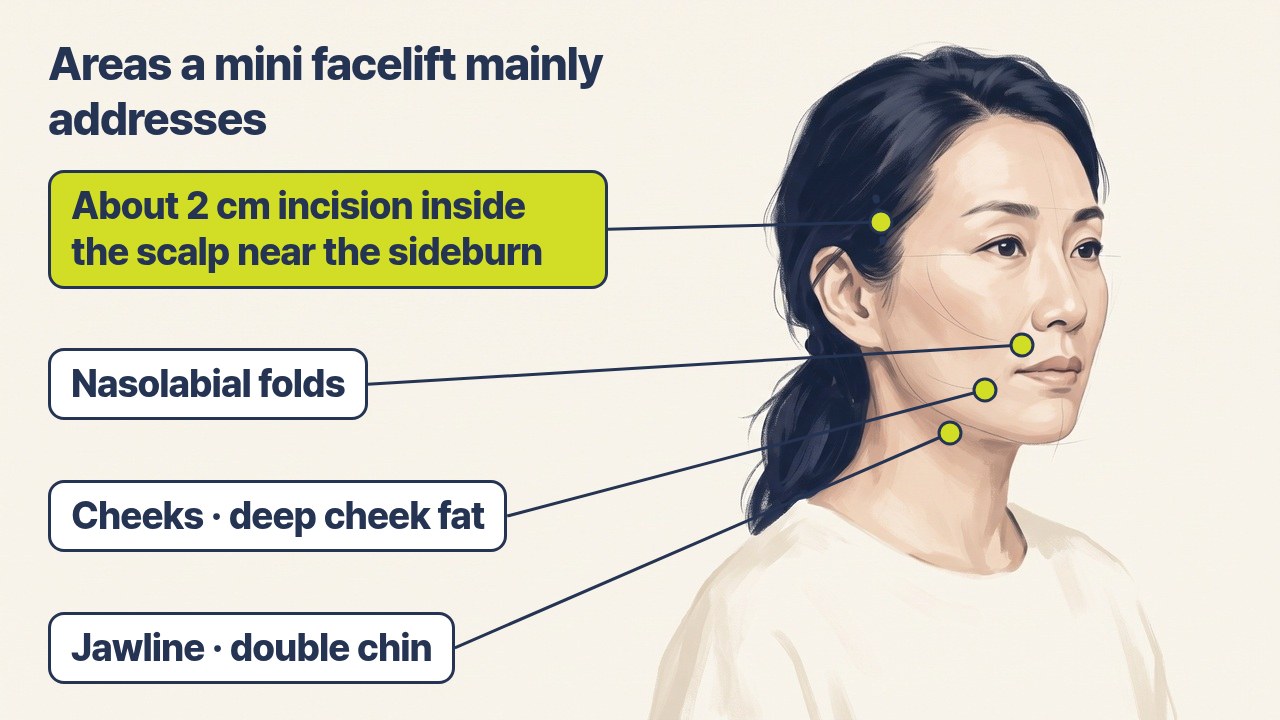
- Cheeks · deep cheek fat — cheek fat that has dropped and looks heavy beside the mouth
- Nasolabial folds — the folds running from the side of the nose to the corners of the mouth
- Jawline · double chin — a loose, blurred jawline and the area under the chin
The comparison table on our website lists the areas for a mini facelift as nasolabial folds, double chin, deep cheek fat, cheek fat and the like, and the areas for a facelift as the whole face down to the neckline. How the incision is planned and in which direction the sagging tissue is lifted are covered in our earlier post ‘1mm Plastic Surgery Facefit Mini-Lift’. This post deals with the question that comes before that: whether your sagging falls within this range.
What kind of sagging points towards a mini facelift consultation?
A common thought
As I get older, will I eventually need a bigger facelift?
The extent of surgery is decided less by age than by where the sagging is and how far it has progressed. Checking the points below in front of a mirror can make it easier to describe your concern at the consultation.
- Do your cheeks and jawline look loose? — This is a concern our website lists as a reason to consider a mini facelift.
- Is the sagging mainly around the mouth and jawline, in the lower face? — This is close to the range a mini facelift addresses.
- Is your aim to lift the sagging areas rather than change your look? — This is one of the aims our website lists for mini facelift candidates.
- Would you like to look first at an approach with a smaller incision? — The incision site and its extent are reviewed together at the consultation.
- Are wrinkles deep across the forehead, around the eyes and down to the neck, or is sagging marked from under the eyes to the cheeks? — In these cases other lift methods are compared as well.
This list is for preparing for a consultation. Whether surgery is needed, and which method fits, is decided at a consultation by examining your face directly.
If the sagging is in a different place, which methods are compared?
Besides the mini facelift, the lifting menu at 1mm Plastic Surgery includes the SMAS facelift, the mid-face lift and the thread lift. The method discussed depends on the area and degree of sagging, and every method has both advantages and points to consider.
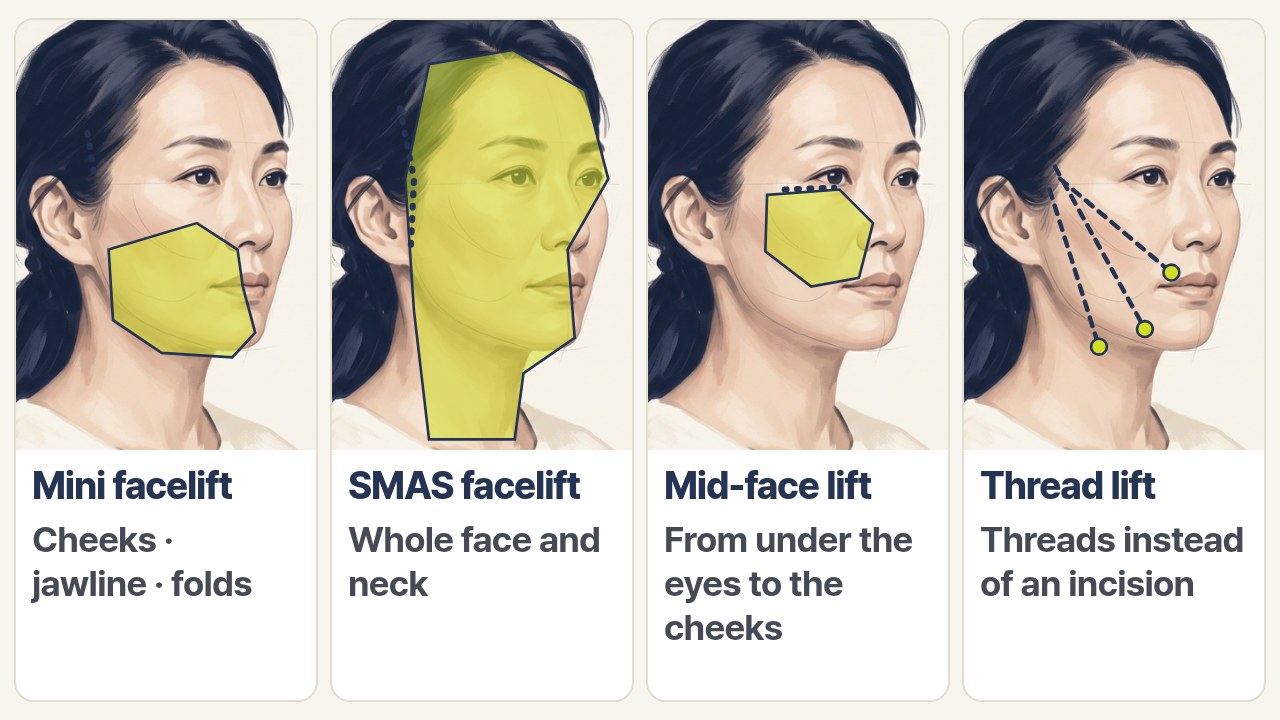
| Item | Mini facelift | SMAS facelift |
|---|---|---|
| Method | Incision of about 2 cm inside the scalp near the sideburn | Incision inside the scalp and along the line in front of the ear |
| Main areas | Cheek fat · deep cheek fat · nasolabial folds · double chin | Forehead · eye area · nasolabial folds · mouth corners · jaw · neck wrinkles |
| Recovery | About 1 week | Usually about 2 weeks to a month |
| Advantages | Small incision placed inside the scalp; part of the sagging skin is removed | Can address the whole face and neck together |
| To consider | Forehead, eye area and neck are outside its range; involves an incision and a recovery period | Wider incision and a longer recovery period |
| Item | Mid-face lift | Thread lift |
|---|---|---|
| Method | Small incision along the line under the eye | Dissolvable threads placed under the skin to lift |
| Main areas | Under-eye sagging · cheek sagging · nasolabial folds | Facial contour · nasolabial folds · cheek fat · double-chin line |
| Recovery | Explained at consultation | Generally a lighter recovery than surgery |
| Advantages | Can address the under-eye area and cheeks together | Can be discussed when incisional surgery feels like a burden |
| To consider | Jawline and neck are outside its range | No skin is removed, so the degree of lift and how long it lasts differ from surgery; avoid opening the mouth wide for 4 weeks |
Compiled from the mini facelift, SMAS facelift, mid-face lift and thread lift pages of the 1mm Plastic Surgery website; recovery periods are also as guided on the website. The surgical method, whether and how far an incision is made, and the recovery period vary from person to person with the degree of sagging and wrinkles.
The facelift page on our website lists, as cases where a facelift is needed, people who were not satisfied with laser treatment or thread lifting, people who want firmness improved across the whole face, and people with deep wrinkles overall. Severe sagging from under the eyes to the cheeks, or deep tear troughs, appear on the mid-face lift page.
On the other hand, when sagging is still mild, energy-based treatments such as laser, or injectable treatments, are sometimes discussed before surgery. The difference between ultrasound and radiofrequency treatments is explained in our earlier post ‘Ultherapy vs Thermage FLX in Korea: Which One Fits Your Concern?’.
What changes can a mini facelift bring, and which concerns fall outside its range?
The change expected from a mini facelift is lifting tissue that has moved downwards to tidy the lines of the lower face.
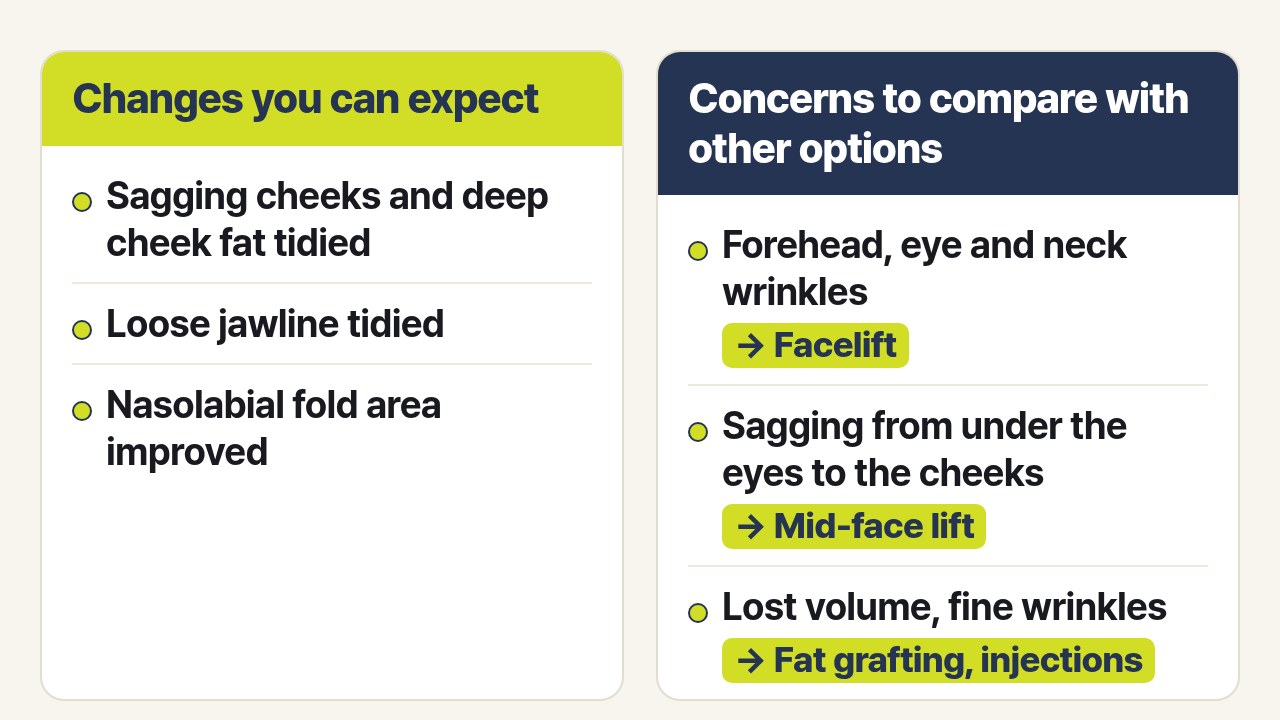
- Cheeks · deep cheek fat — cheek fat that has dropped beside the mouth may look tidier.
- Jawline — a loose jawline may look more defined.
- Nasolabial folds — as the sagging tissue is lifted, the nasolabial fold area may look improved.
Concerns outside its range, or where other methods are also considered
- Forehead, frown-line and eye-area wrinkles; neck wrinkles — our website lists these as areas improved by a facelift.
- Sagging that runs from under the eyes to the cheeks — this is the range of a mid-face lift.
- Lost volume and fine wrinkles — separately from lifting surgery, fat grafting or injectable treatments are sometimes discussed as well.
- Ongoing ageing — even after a lift, sagging can return as time passes.
In short, a mini facelift is not surgery that changes the whole face at once. The degree of change and how long it lasts vary from person to person with the degree of sagging, skin condition and age.
What are the steps of the surgery, and how should you plan for recovery?
The mini facelift steps described on our website come in three stages.
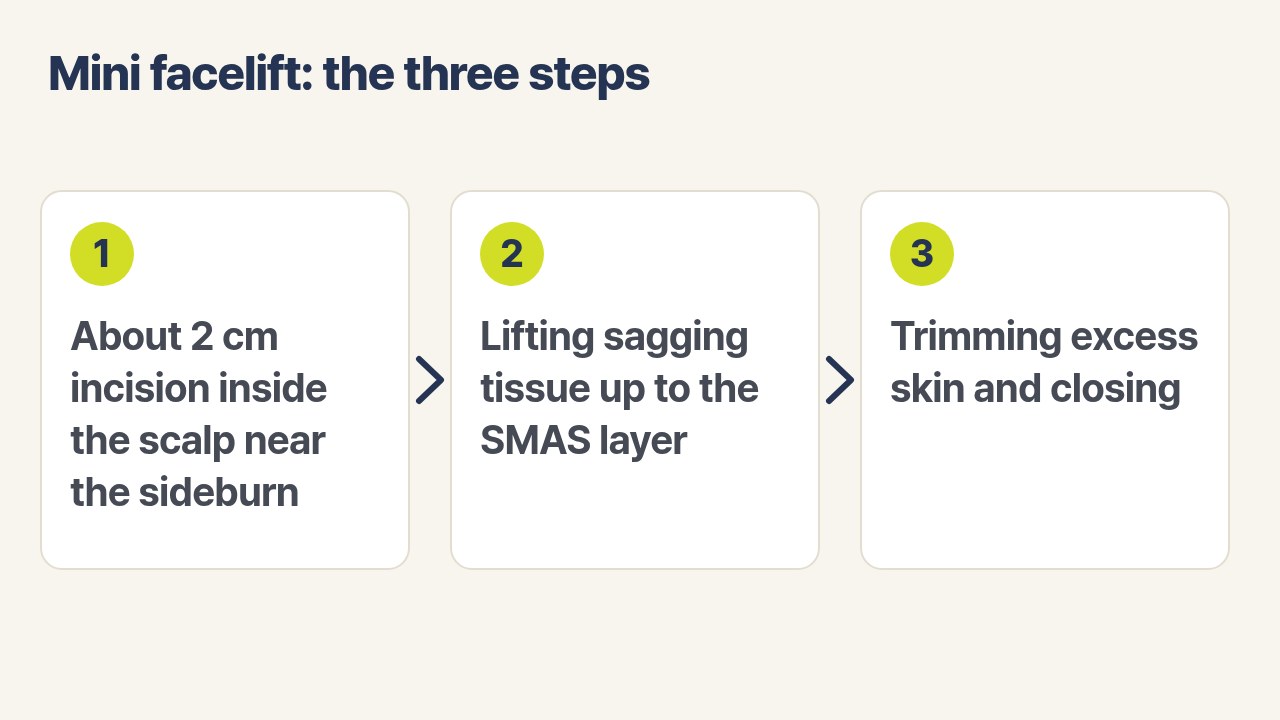
- 1. Incision — an incision of about 2 cm is made inside the scalp near the sideburn. Our website explains that a fine oblique incision is used to reduce damage to the hair and scarring.
- 2. Lifting — sagging tissue is lifted up to the SMAS layer beneath the skin, with the aim of improving the nasolabial fold and deep cheek fat areas.
- 3. Trimming · closing — the skin left over after lifting is trimmed and the incision is closed.
Our website gives the recovery period for a mini facelift as about 1 week. This period can differ from person to person with the degree of sagging and the extent of surgery. How quickly swelling and bruising settle also varies, so if you have an important event coming up, please mention it at the consultation in advance. Please get guidance on recovery, such as when to resume face washing, hair washing and exercise, at your follow-up appointments, tailored to your condition.
Details are on the mini facelift page of our website.
What should you tell us before surgery, and what are the side effects?
A mini facelift uses a relatively small incision, but it is not surgery that is free of side effects. Please tell the medical team the following at your consultation.
- Previous treatments and surgery — facial treatments such as thread lifts or fillers, and previous surgery such as facial contouring
- Medication you are taking — especially medicines that thin the blood
- Health condition — any medical conditions, and whether you smoke
Side effects to know about
- Common recovery reactions — swelling, bruising, a tight feeling or pain can occur. How long they take to settle differs from person to person.
- Bleeding · inflammation — blood can collect at the surgical site (haematoma), and inflammation or infection can occur.
- Scarring · hair — a scar can remain at the incision, and hair around the incision line can become thinner or fall out.
- Sensation · movement — sensation in the surgical area can become dull, or facial expressions can feel awkward.
- Results — the two sides can differ, or the change may feel less than expected.
- If unusual symptoms appear — if pain or swelling suddenly gets worse, or only one side swells a lot, tell the clinic where you had surgery straight away.
Individual differences
Results and the course of recovery vary with each person’s degree of sagging, skin condition and age.
Mini facelift: frequently asked questions
From what age can you have a mini facelift?
It is not decided by age. At the consultation, we look at where the sagging is, how far it has progressed and your skin condition, and decide whether a mini facelift fits or whether other methods should be compared as well.
What is the difference between a thread lift and a mini facelift?
A thread lift is a treatment that places dissolvable threads under the skin to lift it, while a mini facelift is surgery that removes part of the sagging skin through an incision. Our website explains that, for this reason, a mini facelift tends to lift more and its effect tends to last longer. On the other hand, it involves an incision and a recovery period, and the right method depends on the degree of sagging, so it is decided after a consultation.
How long do the results of a mini facelift last?
It is hard to give a set period. Our website explains that results tend to last longer than with a thread lift, and that this can vary with each person’s degree of sagging and wrinkles. Ageing continues after surgery, so sagging can return as time passes.
Where does the mini facelift scar sit?
Because an incision of about 2 cm is made inside the scalp, within the hairline near the sideburn, the scar forms in a place covered by hair. This does not mean that no scar remains, however; how visible it is depends on each person’s skin condition and healing.
What we do at the consultation
Before the name of the surgery,
we look at where and how much you sag
- Checking the sagging areas and degree
- Judging whether it is within mini facelift range
- Comparing pros and cons with other methods
- Recovery schedule and aftercare guidance
We check your facial structure and degree of sagging, and start by judging together whether surgery is needed at all. Results and recovery may vary from person to person.
Consultation and booking
| Enquiries |
[email protected]
Getting in touch in advance can help reduce your waiting time. |
|---|---|
| Telephone | +82-2-552-1171 |
| +82 10-9451-1171 | |
| Opening hours |
Weekdays 10:00 – 19:00 Saturday 10:00 – 16:00 Closed Sundays and public holidays — for holiday opening, please check the monthly schedule notice. |
| Address | 7th, 8th, 9th and 10th floors, Youngshin Building, 449 Gangnam-daero, Seocho-gu, Seoul
In front of Exit 7, Sinnonhyeon Station — a 2-minute walk |
| Website | 1mmpsglobal.com |
#MiniFacelift #MiniFaceliftKorea #SMASFacelift #SaggingCheeks #JawlineMiniLift #NasolabialFolds #DoubleChin #1mmPlasticSurgery #SeoulClinic #KoreanUnderEyeFatSurgery #KoreanEyelidSurgerySpecialist
This post was written by the founder of a medical institution to provide medical information. The face illustrations and diagrams in this post are explanatory images made to aid understanding; they are not real people and not before-and-after images. The interior image is from the ‘Clinic tour’ section of our website and may differ from the actual space. For any treatment or surgery, suitability, results and the course of recovery may vary with each person’s condition, and side effects can occur. Please confirm the details at a consultation.
Clinic Info
Details
- 서울특별시 서초구 강남대로 449 영신빌딩 7, 8, 9, 10층
- 02-552-1171
- Mon-Fri 10:00-19:00Sat 10:00-16:00
- Director 도언록
- 1mmps.com