2026-10-18
Why do double eyelids loosen after surgery? How the suture and incisional methods differ, and what to do
Loosening is not decided by the surgical method alone. Why double eyelids loosen, which eyes are prone to it, and what to do if it happens.
For anyone considering double eyelid surgery, or who has already had it, one common worry is the crease loosening. A crease can weaken or loosen after surgery for a variety of reasons. Not only the surgical method but also your eyelid condition, the characteristics of your tissue and how you recover after surgery are among the many factors that can play a part. Here we look at why double eyelids loosen after surgery, the traits of eyes prone to loosening, how the surgical methods differ, and the right way to respond.
Why do double eyelids loosen after surgery?
[Frequently asked]If my double eyelid loosens, does that mean the surgery went wrong?
Does the suture method loosen easily, and the incisional method never?
If my double eyelid loosens after surgery, do I need another operation?
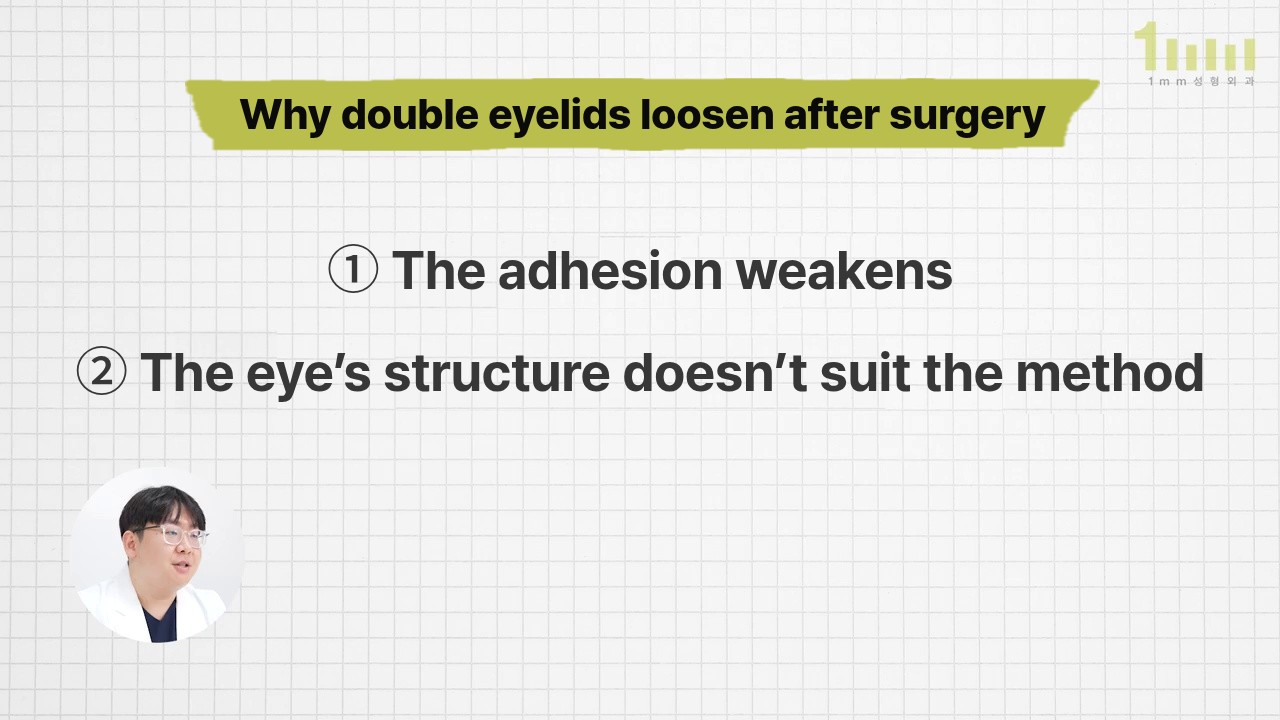
Double eyelid surgery creates a connection between the eyelid skin and the tissue beneath it, so that a crease forms naturally when you open your eyes.
But if this connection weakens or comes loose over time, the crease can fade or disappear.
In particular, how well the crease holds can vary with conditions such as the following.
- Eyelid thickness
- The amount of eyelid fat
- Skin condition
- Tissue characteristics
The key point
In other words, loosening does not arise from one cause alone; several conditions can act in combination.
If a double eyelid loosens, did the surgery go wrong?
A loosened double eyelid is not, on its own, grounds to conclude that the surgery must have gone wrong. Besides the surgical method and how the crease was fixed, factors such as the characteristics of your eyelid tissue and your recovery can also have an effect.
However, in cases like the following, the current condition needs to be checked.
- The crease did not form properly from right after surgery
- The crease on one side alone disappears quickly
It is important to first identify why the loosening happened, and then decide on a correction method that fits.
Do eyes prone to loosening have anything in common?
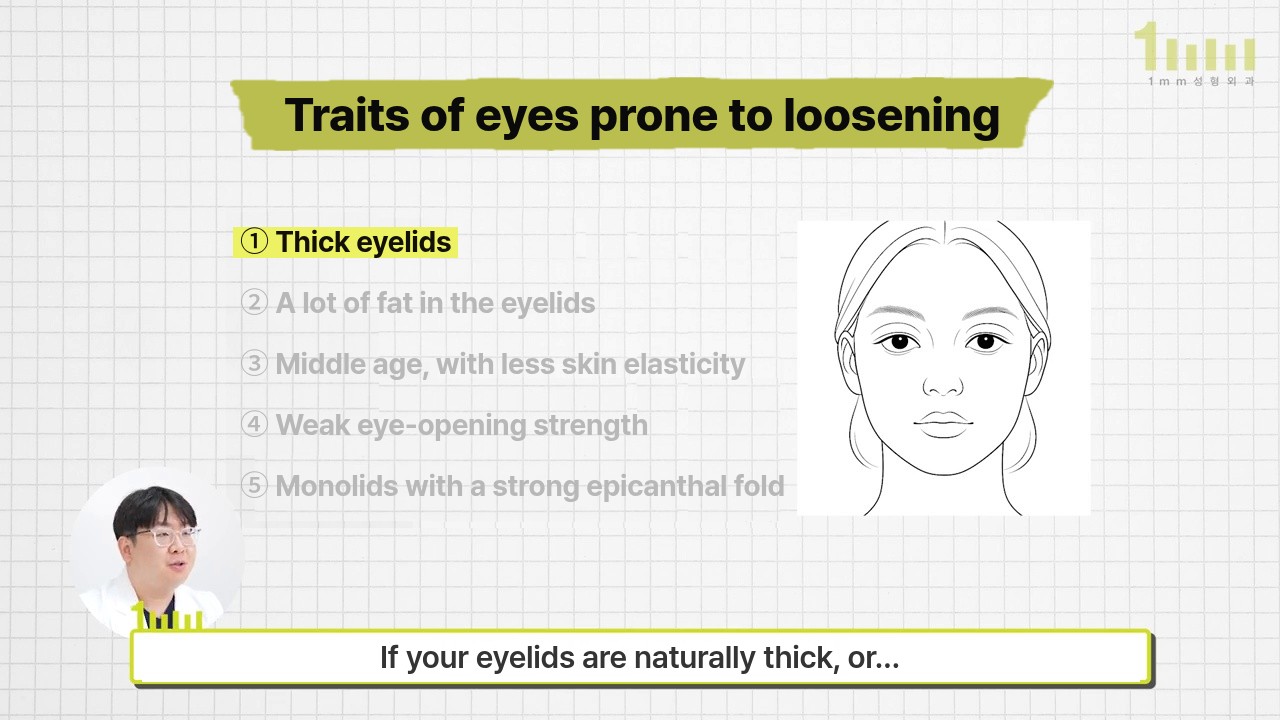
Because eyelid thickness, fat, skin elasticity and the degree of skin laxity differ from person to person, how well a crease holds can differ too. For example:
- Thick eyelids or a lot of eyelid fat — this can be a disadvantage for keeping the crease
- Significant skin laxity — how well the crease will hold needs careful consideration
- Planning a crease that is too high for the structure of the eye — this, too, calls for careful consideration of how well it will hold
What to check before surgery
So before surgery, it is necessary to check the current structure of your eyelids and the condition of the tissue, not just the crease height you want.
Does the suture method always loosen easily?

The suture method forms the crease with thread, through small holes made in the skin. Its incision area is small, but that does not mean a crease made with the suture method will always loosen easily.
Where the eyelid skin is relatively thin, there is little laxity and the conditions suit the surgery, a stable crease can be expected with the suture method too.
Conversely, where the eyelids are thick or skin laxity is significant, it may be difficult to achieve enough holding power with the suture method alone.
In short
In other words, how well a suture-method crease holds can vary not only with the method itself but also with your individual eye condition and how well the method suits it.
Does the incisional method never loosen?
The incisional method involves making an incision in the skin along the crease line, adjusting the necessary tissue, and then forming a connection with the tissue beneath.
A firmer fixation can generally be expected, but choosing the incisional method does not mean there is no chance at all of loosening. Depending on factors such as your tissue condition, how well adhesion forms and your recovery, there is still a possibility that the crease weakens or changes.
| Aspect | Suture method | Incisional method |
|---|---|---|
| Method | Forms the crease using thread through small holes in the skin | Incises the skin along the crease line, adjusts the necessary tissue and forms a connection with the tissue beneath |
| To consider | Its incision area is small | Because the skin is incised, the incision scar and the recovery period also need to be considered |
| Common myth | “It always loosens easily” | “It never loosens” |
| In reality | A stable crease can be expected under suitable conditions, but with thick eyelids or significant laxity it may be difficult to achieve enough holding power with the suture method alone | A firmer fixation can generally be expected, but depending on tissue condition, how well adhesion forms, recovery and so on, the crease may weaken or change |
This table is not a comparison of which method is better; it summarizes common misconceptions about the two methods.
How to choose a method
So rather than thinking of them as ‘the incisional method never loosens and the suture method always does’, it is important to choose the surgical method that suits your eyes.
What should you do if your double eyelid loosens after surgery?
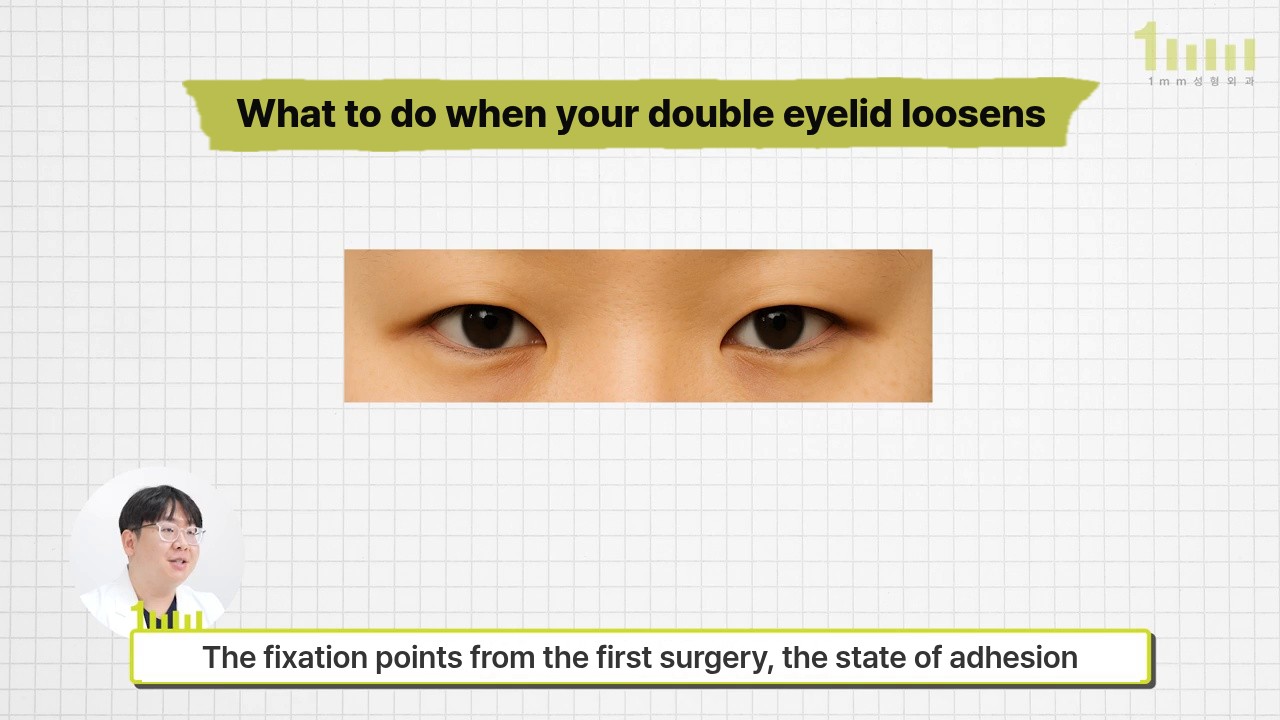
If your crease has faded or disappeared after surgery, its current condition should be checked first. The following points need to be checked in turn.
- It needs to be determined whether this is a temporary change or actual loosening. In the early period after surgery, the crease can look different as swelling goes down and the tissue recovers.
- If it has actually loosened, factors such as the previous surgical method, the state of adhesion, excess skin and the amount of fat need to be examined together.
- A suitable correction method, such as the suture or the incisional method, should be decided after checking the current state of the eyes and the cause of the loosening.
Please keep in mind
Even when revision is needed, the same method as the previous surgery is not automatically applied.
How should you care for your eyes after surgery to keep the crease from loosening?
After double eyelid surgery, caring for the area so that it can recover stably is important. In the early recovery period in particular, it is best to avoid the following.
- Rubbing your eyes hard
- Repeatedly pulling on your eyelids
For activities that can irritate the eyelids, such as washing your face, wearing makeup or wearing contact lenses, it is also important to follow the recovery schedule your medical team gives you.
The limits of aftercare
Of course, not every case of loosening can be prevented through daily habits alone. But reducing unnecessary irritation after surgery and following the precautions you are given can help with a stable recovery.
Loosening: what matters more than the surgical method is the condition of your eyes
Whether a crease loosens after surgery is not determined solely by whether the suture or the incisional method was chosen. That is because conditions of the eye such as the following differ from person to person.
- Eyelid thickness and fat
- Skin laxity
- Eye-opening strength
- The state of adhesion of an existing double eyelid
And if your crease has loosened after a previous surgery, rather than simply fixing it again, it is important to understand in detail why the existing crease loosened and the current condition of the tissue.
In short
So if you are planning double eyelid surgery or are troubled by loosening after surgery, it is important to check the current state of your eyes through a specialist’s diagnosis and a thorough consultation, and then decide on a suitable surgical or correction method.
About side effects
With both the suture and the incisional method, results and recovery can differ depending on the individual’s eye condition, and side effects such as swelling and bruising, asymmetry, inflammation and infection, scarring and loosening of the crease can occur.
Frequently asked questions
If my double eyelid loosens, does that mean the surgery went wrong?
A loosened double eyelid is not, on its own, grounds to conclude that the surgery must have gone wrong. Besides the surgical method and how the crease was fixed, factors such as the characteristics of your eyelid tissue and your recovery can also have an effect. However, if the crease did not form properly from right after surgery, or the crease on one side alone disappears quickly, the current condition needs to be checked.
Does the suture method loosen easily, and the incisional method never?
Rather than thinking of them as ‘the incisional method never loosens and the suture method always does’, it is important to choose the surgical method that suits your eyes. With the suture method, too, a stable crease can be expected where the eyelid skin is relatively thin, there is little laxity and the conditions suit the surgery; but where the eyelids are thick or skin laxity is significant, it may be difficult to achieve enough holding power with the suture method alone. With the incisional method, a firmer fixation can generally be expected, but depending on factors such as your tissue condition, how well adhesion forms and your recovery, there is still a possibility that the crease weakens or changes.
If my double eyelid loosens after surgery, do I need another operation?
First, the current condition needs to be checked. In the early period after surgery, the crease can look different as swelling goes down and the tissue recovers, so it needs to be determined whether this is a temporary change or actual loosening. If it has actually loosened, factors such as the previous surgical method, the state of adhesion, excess skin and the amount of fat should be examined together, and a suitable correction method decided after identifying the cause. Even when revision is needed, the same method as the previous surgery is not automatically applied.
Are some eyes more prone to loosening?
Because eyelid thickness, fat, skin elasticity and the degree of skin laxity differ from person to person, how well a crease holds can differ too. Thick eyelids or a lot of eyelid fat can be a disadvantage for keeping the crease, and with significant skin laxity, or when planning a crease that is too high for the structure of the eye, how well it will hold also needs careful consideration.
Is there a way to care for my eyes after surgery to keep the crease from loosening?
In the early recovery period, it is important to avoid rubbing your eyes hard or repeatedly pulling on your eyelids, and to follow the recovery schedule your medical team gives you for things such as washing your face, wearing makeup and wearing contact lenses. Not every case of loosening can be prevented through daily habits alone, but reducing unnecessary irritation and following the precautions you are given can help with a stable recovery.
What happens in a consultation
Through diagnosis and consultation,
we start by checking your eyes’ conditions together
- Care from a plastic surgery specialist
- One-on-one consultation tailored to your features
- Checking your current eyelid condition
- Discussing the crease and eye shape you want
We look at the crease you want together with the current state of your eyes, and discuss which surgical method suits you.
Consultation and booking
| Enquiries |
global@1mmps.com
Getting in touch in advance can help reduce your waiting time. |
|---|---|
| Telephone | +82-2-552-1171 |
| +82 10-9451-1171 | |
| Opening hours |
Weekdays 10:00 – 19:00 Saturday 10:00 – 16:00 Closed Sundays and public holidays — for holiday opening, please check the monthly schedule notice. |
| Address | 7th, 8th, 9th and 10th floors, Youngshin Building, 449 Gangnam-daero, Seocho-gu, Seoul |
| Website | 1mmpsglobal.com |
#DoubleEyelidLoosening #WhyDoubleEyelidsLoosen #SutureMethod #IncisionalMethod #SutureMethodLoosening #IncisionalDoubleEyelid #EyelidAdhesion #DoubleEyelidAftercare #EyeSurgery #DoubleEyelidSurgery #GangnamPlasticSurgery #1mmPlasticSurgery #1mmps
This post was written by the founder of a medical institution to provide medical information. The images in this post are the thumbnail and explanatory screens from a video on double eyelid loosening produced by 1mm Plastic Surgery, with the on-screen Korean text replaced by English; they are not before-and-after photographs. In the thumbnail, the area under the text (nose and cheeks) was filled in with AI image editing when the Korean text was removed; the eye area is unchanged from the original video frame. For any surgery, its suitability for you, the result and the course of recovery may differ depending on your eye condition and surgical history, and side effects may occur. Please confirm the details through a consultation.
Clinic Info
Details
- 서울특별시 서초구 강남대로 449 영신빌딩 7, 8, 9, 10층
- 02-552-1171
- Mon-Fri 10:00-19:00Sat 10:00-16:00
- Director 도언록
- 1mmps.com