2026-11-21
Non-Incisional Ptosis Correction: Who Qualifies? Four Conditions and When Incisional Is Considered
Non-incisional ptosis correction suits eyes that meet particular conditions. Here are the four conditions, and when the incisional method is considered instead.
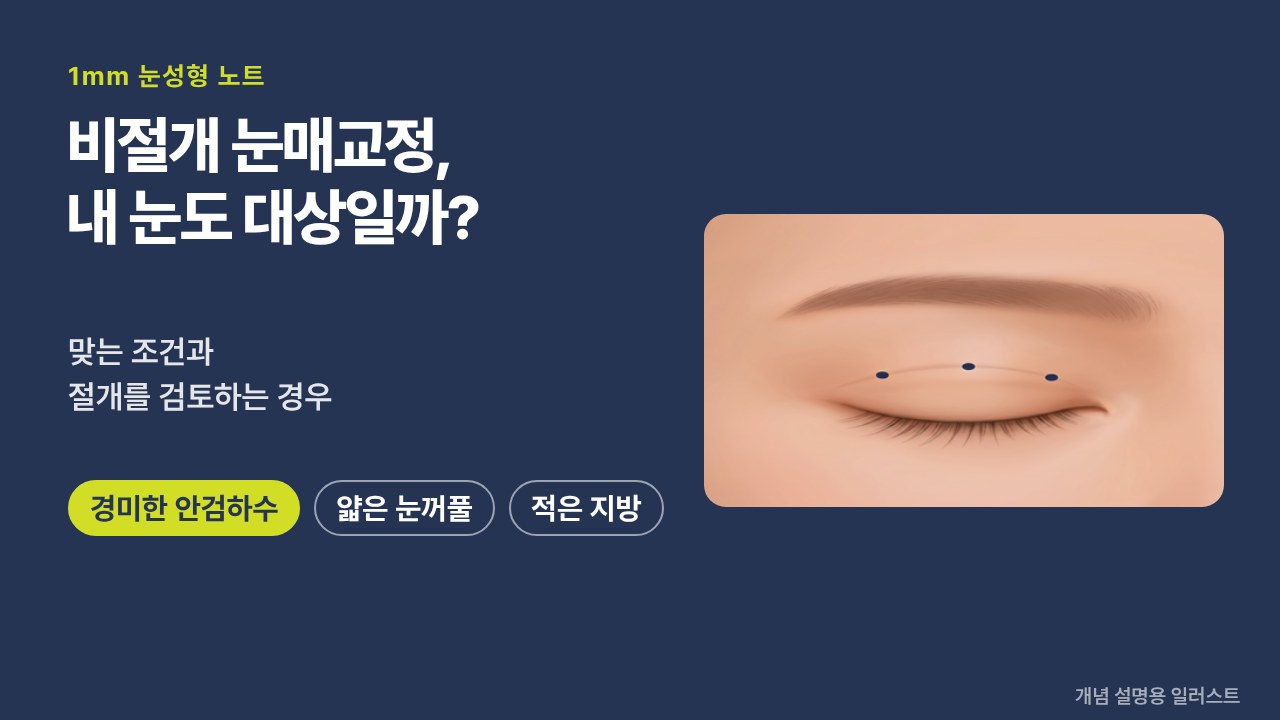
When looking into ptosis correction, you may wonder, ‘An incision feels like a lot — could my eyes be treated with the non-incisional method?’ Non-incisional ptosis correction reinforces eye-opening strength with tiny openings and knots, so there are particular conditions for the eyes it suits. Not wanting an incision is not, on its own, a reason to choose the non-incisional method. This post goes through the four conditions under which non-incisional ptosis correction is considered, and when the incisional method is considered instead because the conditions do not line up.
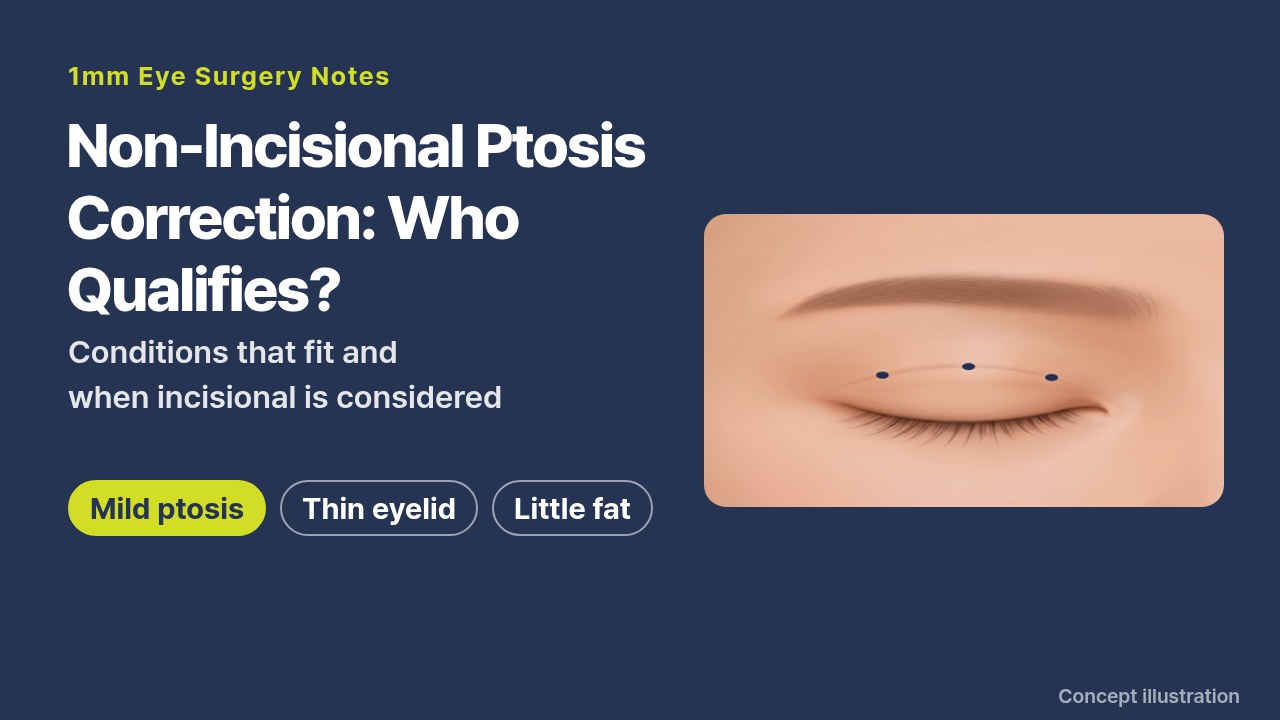
How does non-incisional ptosis correction reinforce eye-opening strength?
A common thought
Non-incisional sounds simpler than incisional, so surely anyone can have it?
Ptosis correction is surgery that adjusts the function that lifts the eyelid, so that the amount of iris showing when you open your eyes is set right. A state in which eye-opening strength is weak is commonly called ptosis. Depending on the method, ptosis correction is broadly divided into non-incisional and incisional.
Non-incisional ptosis correction, as described in the 1mm Plastic Surgery ptosis correction guide, proceeds in the following order.
- Design — Before surgery, the eye shape you want is designed.
- Tiny openings — Tiny openings are made in the eyelid along the designed line.
- Knots — Knots are made to reinforce eye-opening strength, and the same knots set the double eyelid line.
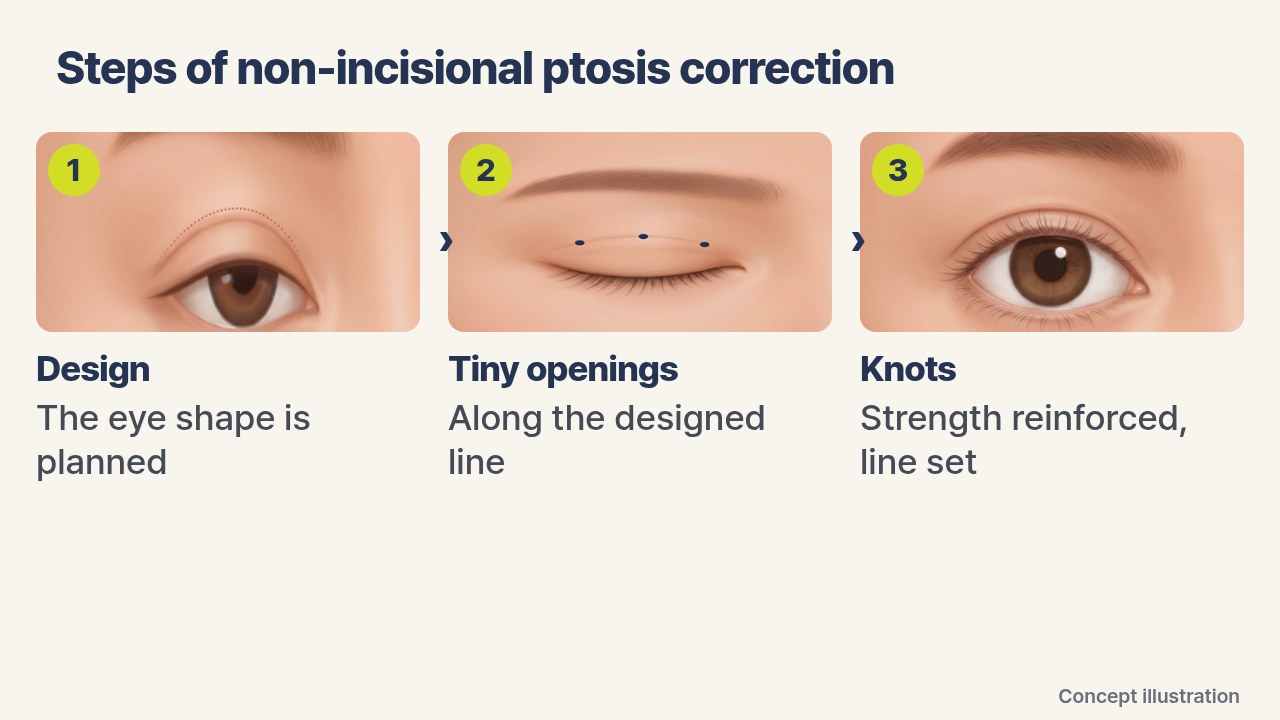
In this way, non-incisional ptosis correction reinforces eye-opening strength with knots, without making a long incision in the skin. That is why the burden of scarring tends to be lower. For the same reason, however, removing fat from inside the eyelid is hardly possible. This is why there are particular conditions for the eyes that suit the non-incisional method.
Which eyes suit non-incisional ptosis correction, and which conditions are checked together?
The 1mm Plastic Surgery ptosis correction guide lists the following four cases in which non-incisional ptosis correction is considered.
- The ptosis is mild — Eye-opening strength is slightly insufficient, enough to give a sleepy look. This is distinguished from severe cases in which the eyelid covers much of the upper iris or opening the eyes feels uncomfortable.
- Eyelid sagging is not severe — If skin that has lost elasticity covers much of the area above the lashes, other methods such as upper blepharoplasty or a sub-brow lift may also be considered.
- The eyelid is thin with little fat — Because fat removal is hardly possible with the non-incisional method, it is considered for eyes with thin eyelids.
- The eyes have not changed after double eyelid surgery — This is when there is no change in the eyes even after double eyelid surgery. It is covered separately below.
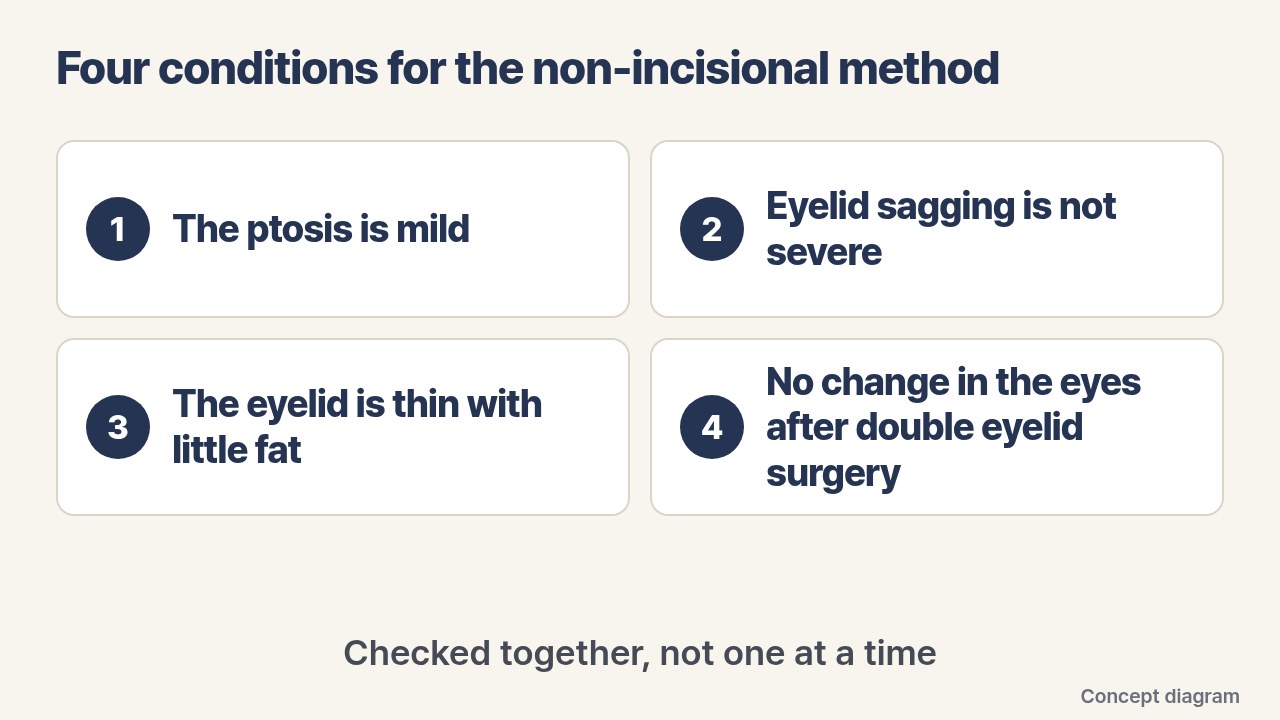
These conditions are not looked at one at a time but are checked together. Even if the ptosis is mild, other methods may also be considered if the eyelid is thick; likewise if the eyelid is thin but the ptosis is severe. Also, meeting the conditions above does not mean ptosis correction is necessary. Whether the non-incisional method suits you is judged through an examination.
If the ptosis is mild but the eyelid is thick, is it still non-incisional?
What is easy to confuse is an eye where the conditions do not line up. The 1mm Plastic Surgery ptosis correction guide presents thick skin with more fat and severe ptosis as cases in which incisional ptosis correction is considered. So when the two criteria are laid over each other, the box in which the non-incisional method is considered narrows to ‘mild ptosis with a thin eyelid and little fat’.
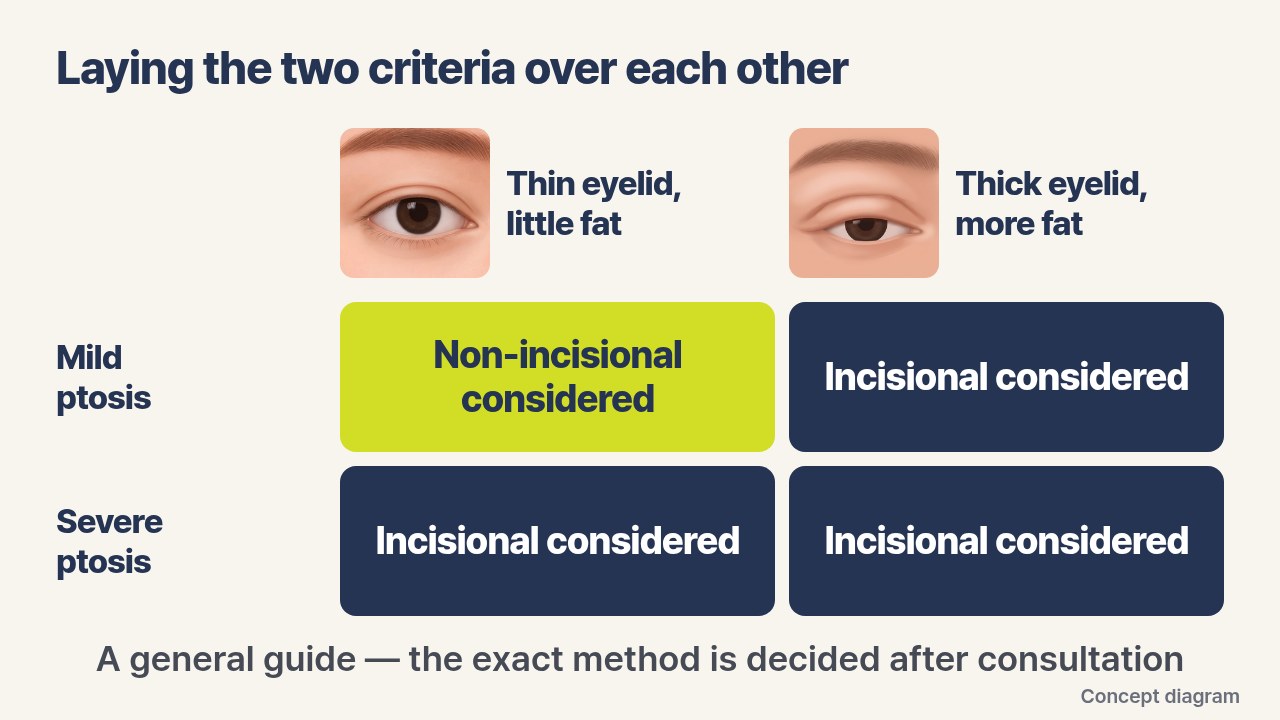
If the eyelid is thick with more fat, the eyes can look heavy, and fat removal is hardly possible with the non-incisional method. In such cases, incisional ptosis correction, which can also deal with fat through the incision, is often considered. Each method has its advantages and points to consider.
| Item | Non-incisional method | Incisional method |
|---|---|---|
| Method | Reinforces eye-opening strength and sets the line with tiny openings and knots | After an incision, the eye-opening muscle is pulled and tied to adjust its length |
| Mainly considered for | Ptosis that is not severe, with a thin eyelid and little fat | Severe ptosis, or thick skin with more fat |
| Advantages | No long incision in the skin, so the burden of scarring tends to be lower | Can be applied in most cases, and fat can be dealt with at the same time |
| Points to consider | Fat removal is hardly possible, and it may not suit severe ptosis | Fine scarring may remain |
The table summarises general criteria and is not a fixed formula. The exact surgical method is decided after an examination and consultation.
If your eyes look the same even after double eyelid surgery, can non-incisional ptosis correction be considered?
This is the fourth condition, ‘the eyes have not changed after double eyelid surgery’. The 1mm Plastic Surgery ptosis correction guide explains that if there are symptoms of ptosis and only double eyelid surgery is done, with no ptosis correction, the double eyelid may look loosened or the eyes may look sleepy. This is because double eyelid surgery creates a line, while the function of lifting the eyelid is what ptosis correction deals with.
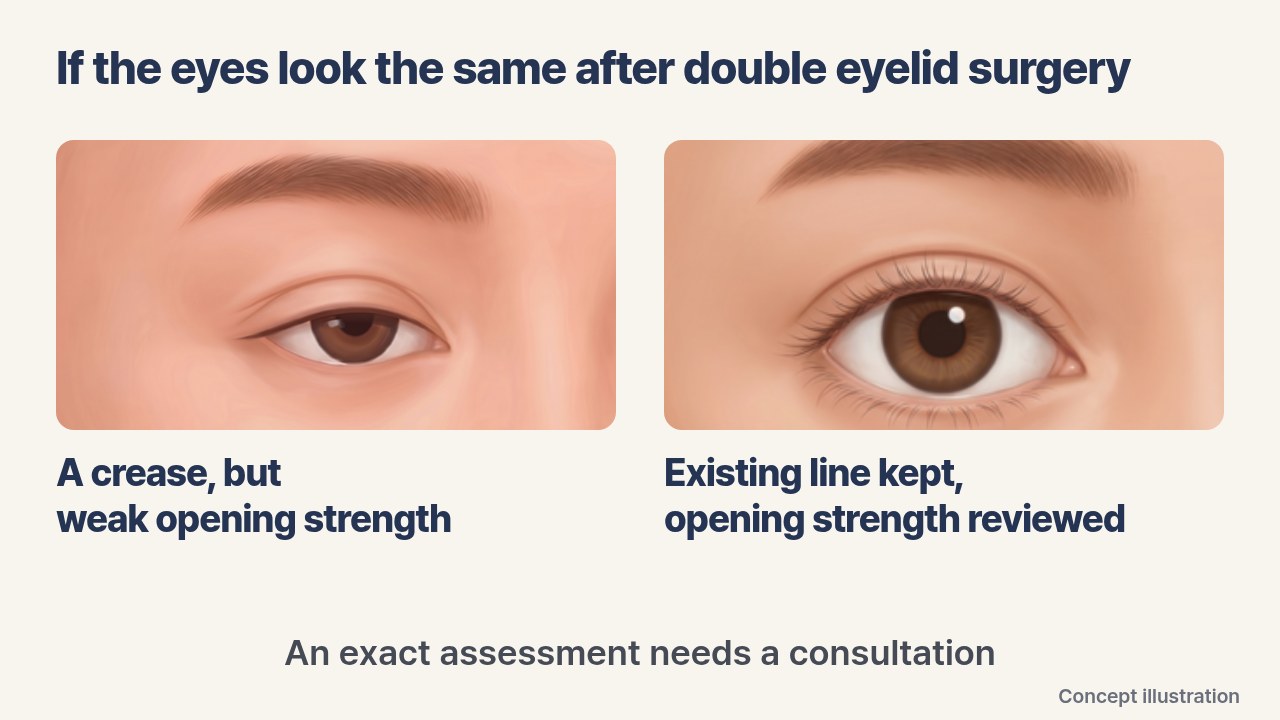
Even if you have already had double eyelid surgery, ptosis correction can be considered without touching the existing double eyelid line if eye-opening strength is insufficient. Here too, whether to use the non-incisional method is decided by looking at the conditions above together: the degree of ptosis and the thickness and fat of the eyelid.
For eyes that have already had surgery, however, we also check whether the tissue of the eye has settled since the previous surgery. And because the reason for a sleepy look may lie elsewhere rather than in eye-opening strength, the cause is checked first.
Not every sleepy look comes from eye-opening strength. If sagging skin or a sunken upper eyelid is the bigger cause, another method may be considered first. How to tell apart the causes of a sleepy look is covered in “Sleepy Eyes or Ptosis?”, and when double eyelid surgery and ptosis correction are considered together is covered in “Ptosis Correction with Double Eyelid Surgery”.
What should you know about recovery and side effects after non-incisional ptosis correction?
Non-incisional ptosis correction does not involve a long incision in the skin, but it is surgery, so there is a recovery process and side effects may occur. Because tiny openings are made and eye-opening strength is reinforced with knots, the degree of correction needs to be checked along with the course of recovery. The recovery period differs depending on the condition of your eyes and is explained individually during the consultation.
Side effects and points to note
Common recovery reactions — Swelling, bruising and a difference between the two sides may occur. The course of recovery differs from person to person and is checked through a consultation.
Eye discomfort — You may feel a gritty or tight sensation, a foreign-body sensation or dryness.
Degree of correction — If the eye is corrected more than needed, the eyes may feel as if they open too wide. That is why it is important to correct within the range your current condition needs. Depending on the individual, the degree of correction and differences between the sides may not match what you expect.
Double eyelid line — If the fixation was not secure enough, the line may loosen in some cases.
Scarring — Scars may remain at the tiny opening sites, and the course of recovery differs from person to person.
When only one side is done — If only one side is corrected, the two sides may become uneven again later.
Symptoms to report to your surgeon right away — If you have severe pain or pressure in the eye that painkillers do not control, an eye that does not close fully, a scar that becomes red and hard, a small lump you can feel, or recurring inflammation, seek care right away.
Non-incisional ptosis correction: frequently asked questions
Does non-incisional ptosis correction also create a double eyelid line?
In the non-incisional method described in the 1mm Plastic Surgery ptosis correction guide, knots reinforce eye-opening strength, and the same knots set the double eyelid line. The shape of the line is decided through consultation at the design stage before surgery. Results may vary from person to person.
Can the double eyelid line loosen after non-incisional ptosis correction?
It can. Because non-incisional ptosis correction also sets the double eyelid line with knots, the line may loosen in some cases if the fixation was not secure enough. If you feel the line has changed, see the clinic where you had surgery to find out the cause.
I have to use my forehead to open my eyes. Can I have the non-incisional method?
The 1mm Plastic Surgery ptosis correction guide presents cases where weak eye-opening strength makes you use your forehead a lot as cases in which incisional ptosis correction is considered. However, how much the forehead is used and the condition of the eyelid differ from person to person, so which method suits you is judged through an examination.
How can I tell whether my eyes qualify for non-incisional ptosis correction?
First, we look at how much of the iris shows when you open your eyes comfortably. The 1mm Plastic Surgery ptosis correction guide explains that about 80% of the iris showing is regarded as the normal range, and less than that can give a sleepy look. This number is only one reference point, however, and the actual judgment is made through a consultation. Whether the non-incisional method suits you is decided by also looking at eyelid sagging, thickness and fat.
What happens in a consultation
Before asking ‘Will non-incisional work?’,
we check the conditions of your eyes together
- Checking how much of the iris shows when you open your eyes comfortably
- Checking eyelid skin sagging, thickness and fat
- Checking previous double eyelid surgery and differences between the sides
- Explaining which of the non-incisional and incisional methods suits you, and side effects
We check the structure of your eyes together with the function of opening them, and discuss which surgical method suits you. Results and the course of recovery may differ from person to person. Surgical methods are also described in the 1mm Plastic Surgery ptosis correction guide.

Consultation and booking
| Enquiries |
[email protected]
Getting in touch in advance can help reduce your waiting time. |
|---|---|
| Telephone | +82-2-552-1171 |
| +82 10-9451-1171 | |
| Opening hours |
Weekdays 10:00 – 19:00 Saturday 10:00 – 16:00 Closed Sundays and public holidays — for holiday opening, please check the monthly schedule notice. |
| Address | 7th, 8th, 9th and 10th floors, Youngshin Building, 449 Gangnam-daero, Seocho-gu, Seoul
In front of Exit 7, Sinnonhyeon Station — a 2-minute walk |
| Website | 1mmpsglobal.com |
#NonIncisionalPtosisCorrection #PtosisCorrection #Ptosis #IncisionalPtosisCorrection #EyeOpeningStrength #SleepyEyes #EyeSurgeryKorea #1mmPlasticSurgery #KoreanEyelidSurgerySpecialist #IncisionalDoubleEyelidSurgery #EpicanthoplastySurgery
This post was written by the founder of a medical institution to provide medical information. The eye images in this post are concept illustrations and diagrams made to aid understanding; they do not show real people and are not before-and-after images. The interior image is from the ‘Clinic tour’ on our website and may differ from the actual premises. For any surgery, its suitability for you, the result and the course of recovery may differ depending on your eye condition, and side effects may occur. Please confirm the details through a consultation.
Clinic Info
Details
- 서울특별시 서초구 강남대로 449 영신빌딩 7, 8, 9, 10층
- 02-552-1171
- Mon-Fri 10:00-19:00Sat 10:00-16:00
- Director 도언록
- 1mmps.com