2026-11-28
In-Out Line vs In-Line Double Eyelid: What Is the Difference, and Which Suits Your Eyes?
In-line and in-out double eyelid lines differ in how the line starts at the inner corner. Here is how they differ and what to check when choosing.
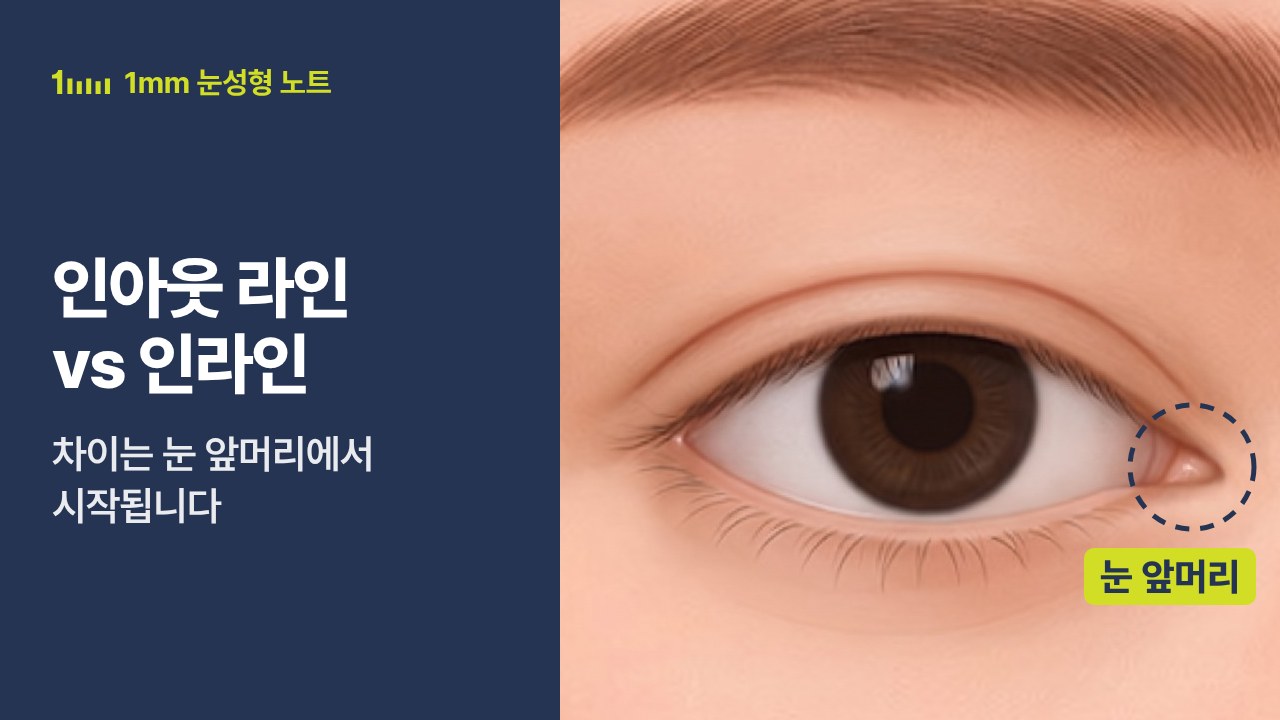
The in-line and the in-out line are told apart by how the double eyelid line starts at the inner corner of the eye. The names sound alike, but the front of the eye looks different when the eyes are open, and the same line can appear differently depending on the structure of your inner corner. Neither one is a better line for everyone. Here we explain how the two lines differ and what to look at together when choosing.
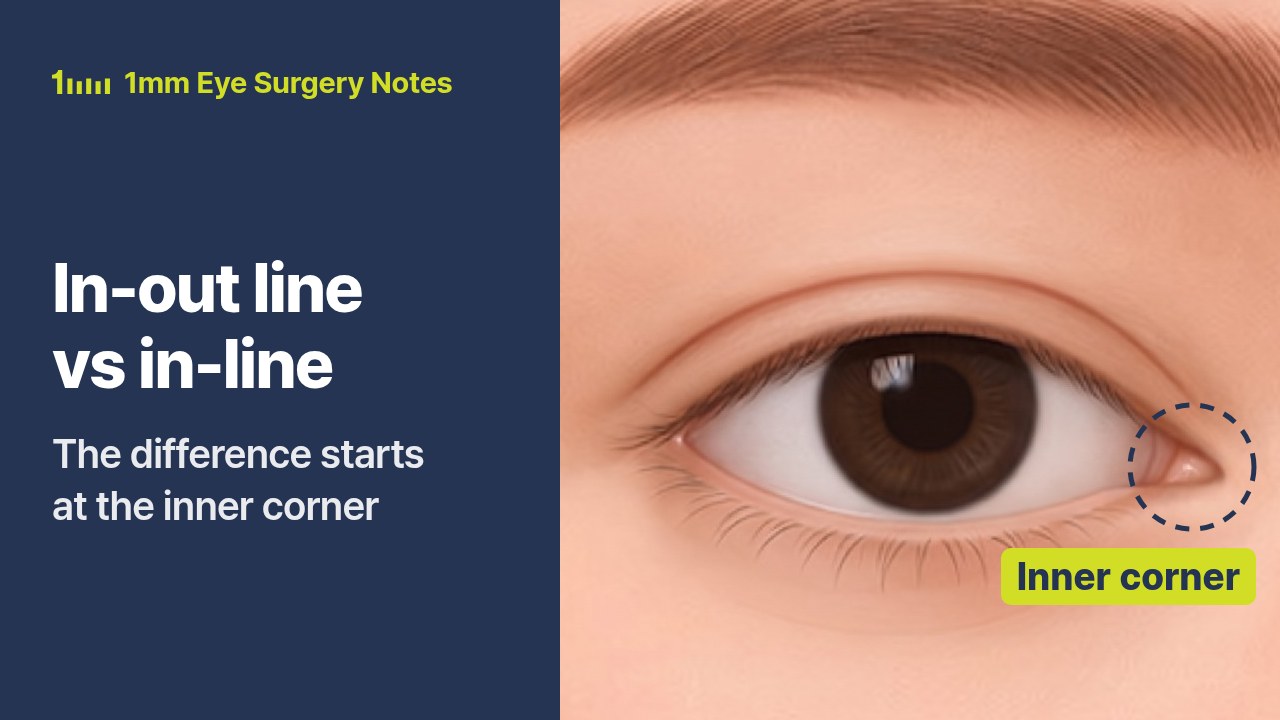
In-out line vs in-line double eyelid: where do they differ?
Most double eyelid line names describe where the line starts. On its incisional double eyelid page, 1mm Plastic Surgery groups double eyelid lines into five types according to their starting position.
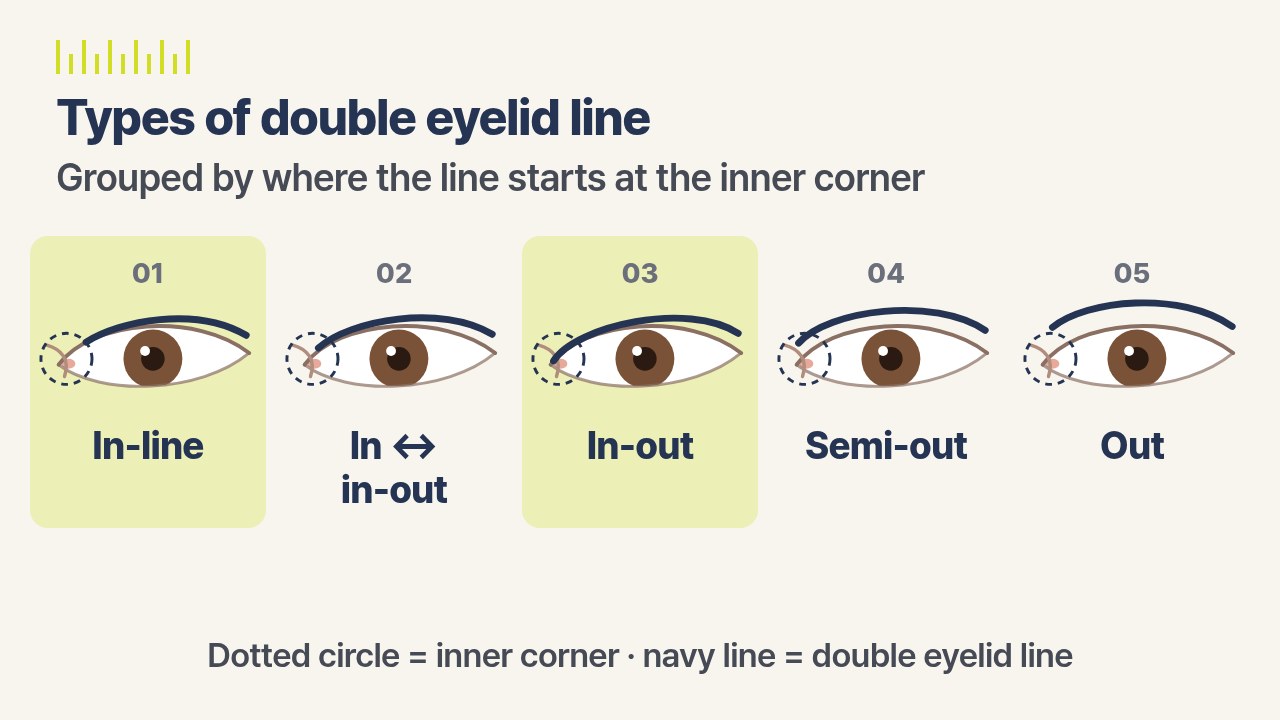
- In-line — the line is not visible on the inner-corner side.
- Between in and in-out — the line starts from a point slightly away from the inner corner and connects from there.
- In-out line — the line starts connected to the inner corner and the line is visible.
- Semi-out line — starts higher than an in-out line but lower than an out-line.
- Out-line — the line does not touch the inner corner and shows higher up.
The in-line and in-out line compared in this post are the first and third types in this order, with an in-between line between them. Both start close to the inner corner, but they differ in whether or not the line can be seen on the inner-corner side.
Starting point and height are separate
The line type refers to the starting point. The height of the line is a separate element decided at the design stage. So even with the same in-out line, the look can differ depending on its height.
How do the two lines look different when the eyes are open?
The two lines differ on the inner-corner side.
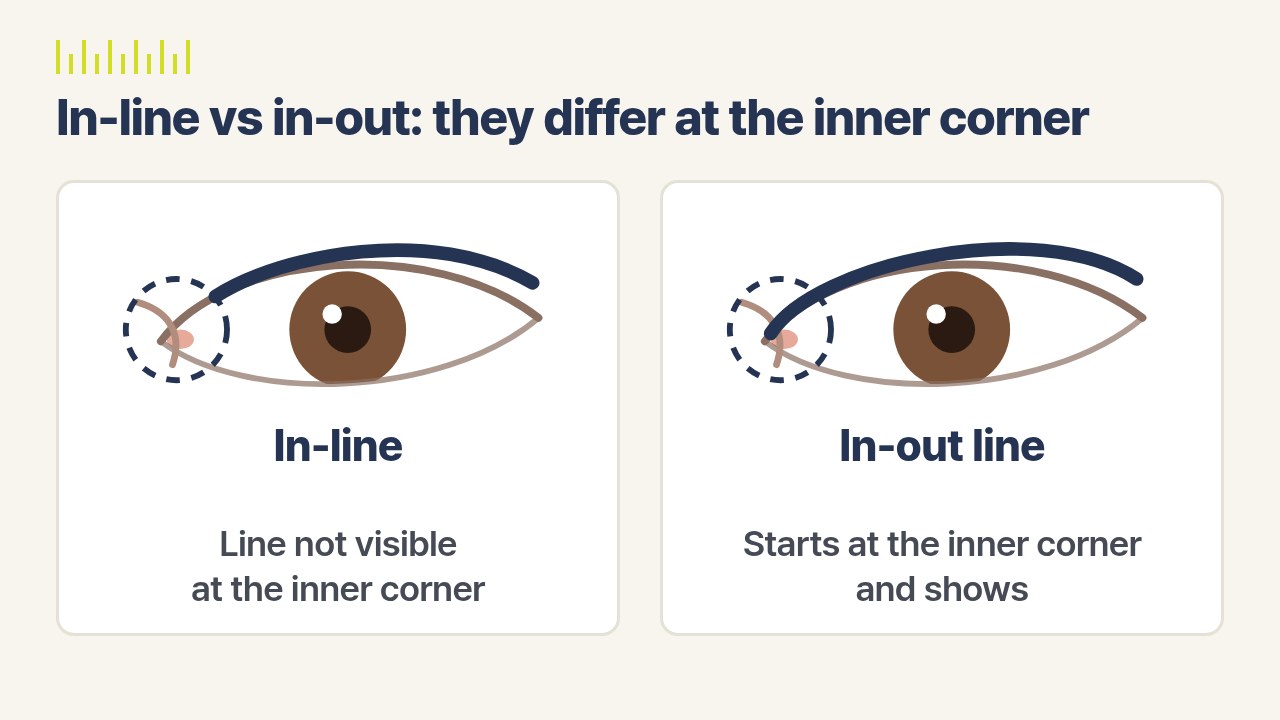
With the in-line, the line tucks inside the inner corner, so the line on the inner-corner side is not visible.
The in-out line starts where the line’s starting point connects with the inner corner, and the line is visible.
| Point | In-line | In-out line |
|---|---|---|
| At the inner corner | Line is not visible | Line starts connected to the inner corner |
| Worth raising if you want | No visible line on the inner-corner side | A line that shows from the front |
| Points to consider | The line is hard to see at the front | The front can look different depending on the inner-corner structure |
Based on the line types on the 1mm Plastic Surgery website. How a line actually looks differs with each person’s eye condition.
Will the line in a photo look the same on my eyes?
Many people use photos as a reference when choosing a line. You might think something like this.
A common thought
Can’t I just ask for an in-out line like the one in this photo?
But a line is not a drawing on the eyelid; it is a result that sits on top of the eye’s structure. If the four points below differ, the same line design can appear differently.
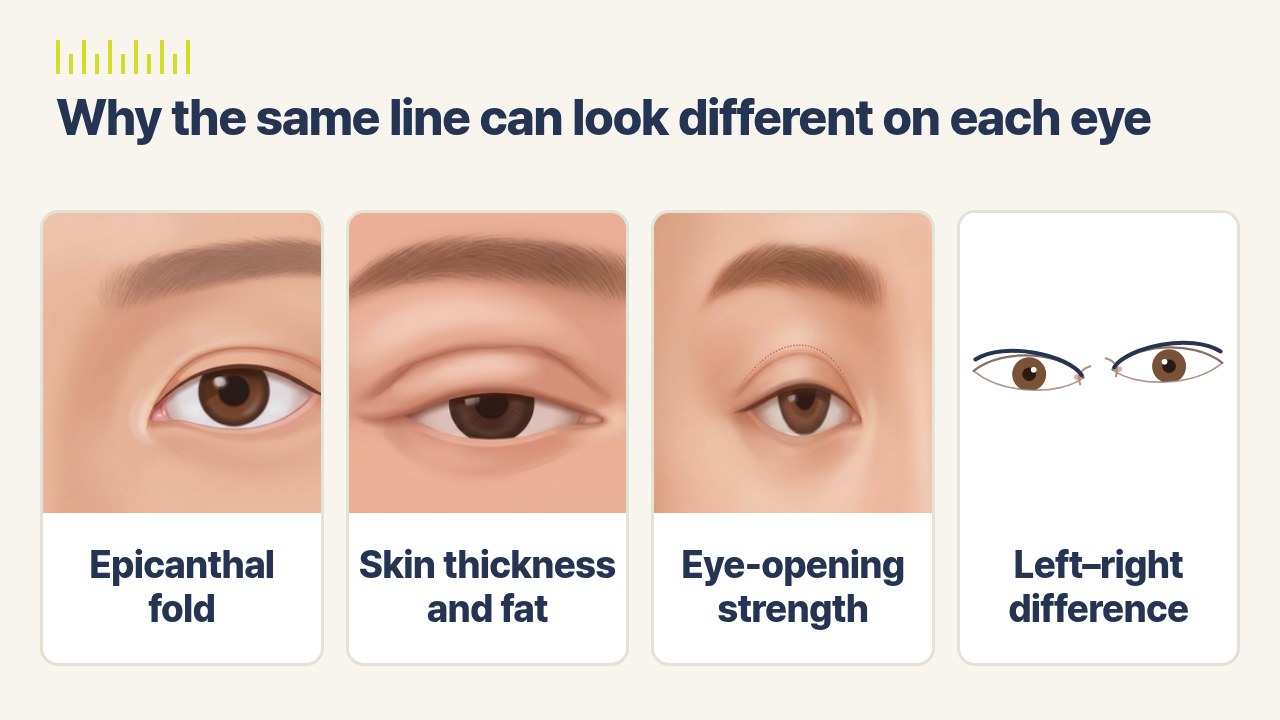
- Epicanthal fold — the fold that covers the inner corner. How much it covers the inner corner, and in what shape, can change how the start of the line looks.
- Eyelid skin thickness and amount of fat — thick skin or a lot of fat can change how much the line looks covered. These are also considered when choosing the surgical method.
- Eye-opening strength — if the eye-opening strength is weak, double eyelid surgery alone may leave the line looking loosened or the eyes looking sleepy. In such cases, ptosis correction may be considered together.
- Left–right difference — a person’s two eyes are never exactly the same. So the line is planned by looking at the right and left eyes separately.
So when you bring a photo, it helps the consultation more to talk about the ‘feel’ of that line rather than the line of the person in the photo. If the line terms are still unfamiliar, you may want to read our post on eight eyelid surgery terms first.
Is an in-out line difficult if I have an epicanthal fold?
The in-out line is a shape in which the line starts connected to the inner corner. So, depending on how much and in what shape the epicanthal fold covers the inner corner, the front part of the line can look different.
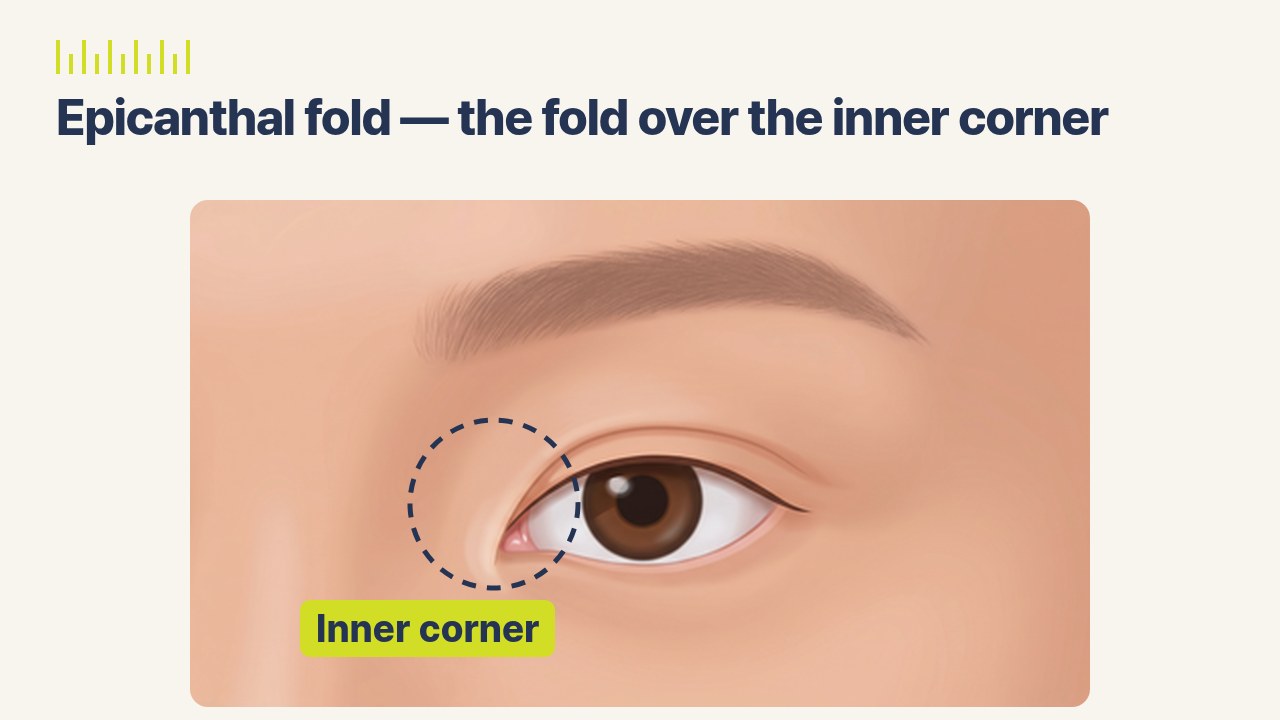
When the epicanthal fold makes it hard to create the desired front shape with the double eyelid line alone, surgery on the inner corner, such as medial epicanthoplasty or upper epicanthoplasty, may also be discussed. Medial epicanthoplasty adjusts the epicanthal fold covering the front of the eye, and upper epicanthoplasty can be performed taking into account factors such as the inner-corner shape and how it connects with the double eyelid line.
However, having an epicanthal fold does not mean everyone needs canthoplasty as well. Depending on the current structure of the eye, double eyelid surgery alone may be enough. On the other hand, if you would like the line not to show on the inner-corner side, you can also talk about the in-line. Either way, the decision is made after checking the inner corner in person.
What should be checked when deciding the line in a consultation?
At 1mm Plastic Surgery, with both the suture method and the incisional method, the line is designed in a one-to-one consultation before surgery. Rather than picking just a line name, checking the points below together helps you understand your line plan.
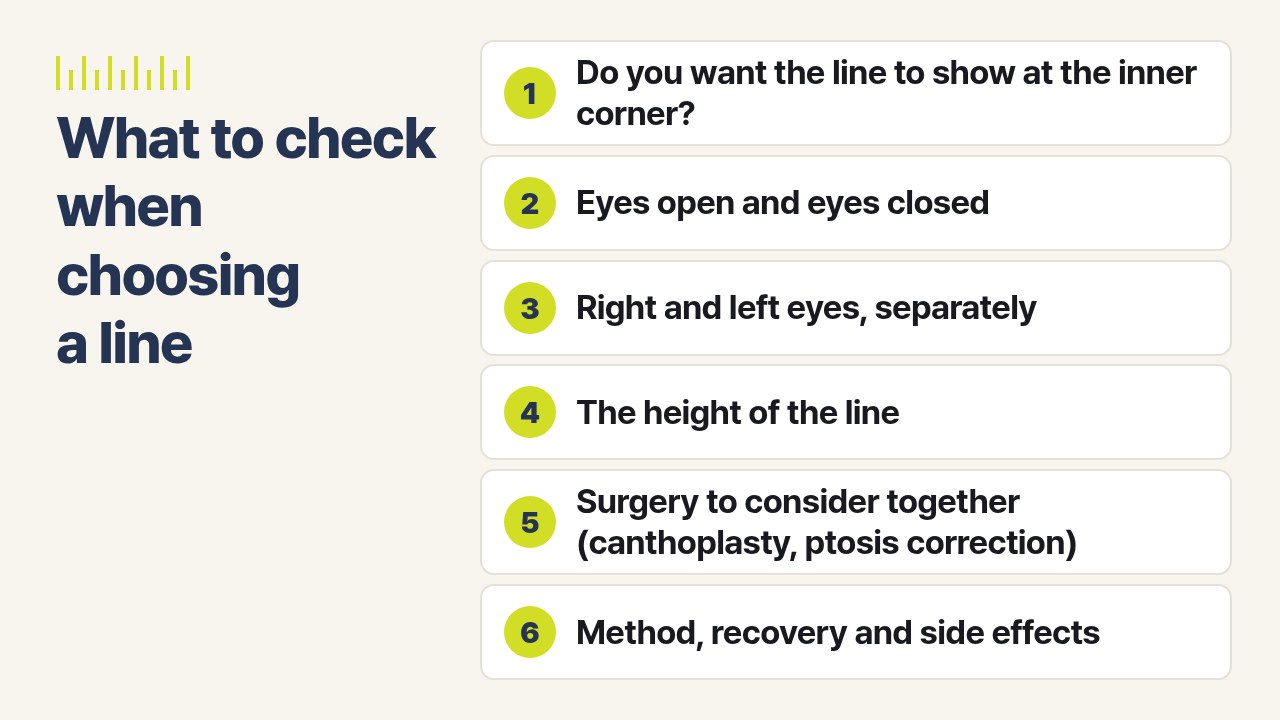
- Whether you want the line to show at the inner corner — this is the question that separates the in-line from the in-out line. Try saying this wish before naming a line.
- Eyes open and eyes closed — look together at how the line will appear in both states.
- Right and left eyes, separately — the condition of each eye is checked separately.
- The height of the line — the line height is decided along with the starting point.
- Surgery to consider together — depending on the epicanthal fold or eye-opening strength, check whether canthoplasty or ptosis correction is needed.
- Method, recovery and side effects — hear which of the suture or incisional method suits you, along with the recovery process and side effects.
About side effects
Regardless of the line type, with both the suture and incisional methods, results and recovery can differ depending on the individual’s eye condition, and side effects such as swelling and bruising, asymmetry, inflammation and infection, scarring and loosening of the crease can occur. If canthoplasty or ptosis correction is done together, you also hear about that surgery’s recovery and side effects separately before deciding.
In-out line and in-line: frequently asked questions
Is the in-out line or the in-line more natural-looking?
There is no set answer. Whether a line looks natural depends less on its name than on the structure of your inner corner, the condition of your eyelids and the impression you want. The suitable line is decided together after checking your eyes.
How is a semi-out line different from an in-out line?
In the line types on the 1mm Plastic Surgery website, a semi-out line starts higher than an in-out line but lower than an out-line. The height at which the line starts near the inner corner is different.
Is the line also designed before surgery with the suture method?
With both the suture and incisional methods, the line is decided at the design stage before surgery. Which method suits you depends on eyelid skin thickness, the amount of fat and the degree of sagging, so the line you want and the surgical method are discussed together.
What is the line between in and in-out?
In the 1mm Plastic Surgery website’s classification, the line between in and in-out starts from a point slightly away from the inner corner and connects from there. In the order of the five types, it sits between the in-line and the in-out line. Which line suits you is decided together in the consultation after your eye condition is checked.
What happens in a consultation
Before the line name,
we look at your inner corner
- Checking the inner corner and epicanthal fold
- Checking eyelid skin, fat and eye-opening strength
- Designing the line by looking at each eye separately
- Explaining line type, height and surgical method
We check each person’s eye condition and discuss a suitable line and surgical direction. Results and recovery may differ from person to person.
Consultation and booking
| Enquiries |
[email protected]
Getting in touch in advance can help reduce your waiting time. |
|---|---|
| Telephone | +82-2-552-1171 |
| +82 10-9451-1171 | |
| Opening hours |
Weekdays 10:00 – 19:00 Saturday 10:00 – 16:00 Closed Sundays and public holidays — for holiday opening, please check the monthly schedule notice. |
| Address | 7th, 8th, 9th and 10th floors, Youngshin Building, 449 Gangnam-daero, Seocho-gu, Seoul
Right by Exit 7 of Sinnonhyeon Station, a 2-minute walk |
| Website | 1mmpsglobal.com |
#InOutLine #InLineDoubleEyelid #DoubleEyelidLine #DoubleEyelidSurgery #EpicanthalFold #EyeSurgery #1mmPlasticSurgery #1mmps #EpicanthoplastySurgery #WideNoseReductionRhinoplasty #JuvelookSkinBooster
This post was written by the founder of a medical institution to provide medical information. The double eyelid line types follow the incisional double eyelid page of the 1mm Plastic Surgery website. The images in this post are explanatory diagrams and illustrations made to aid understanding; they do not show real people and are not before-and-after comparisons. For any surgery, its suitability for you, the result and the course of recovery may differ depending on your eye condition, and side effects may occur. Please confirm the details through a consultation.
Clinic Info
Details
- 서울특별시 서초구 강남대로 449 영신빌딩 7, 8, 9, 10층
- 02-552-1171
- Mon-Fri 10:00-19:00Sat 10:00-16:00
- Director 도언록
- 1mmps.com