2026-11-23
Double Eyelid Surgery Recovery Day by Day: What Changes From the First 3 Days to 6 Months
Double eyelid surgery recovery split into the first 3 days, 2–3 weeks and one to six months — what changes and what to do in each period.
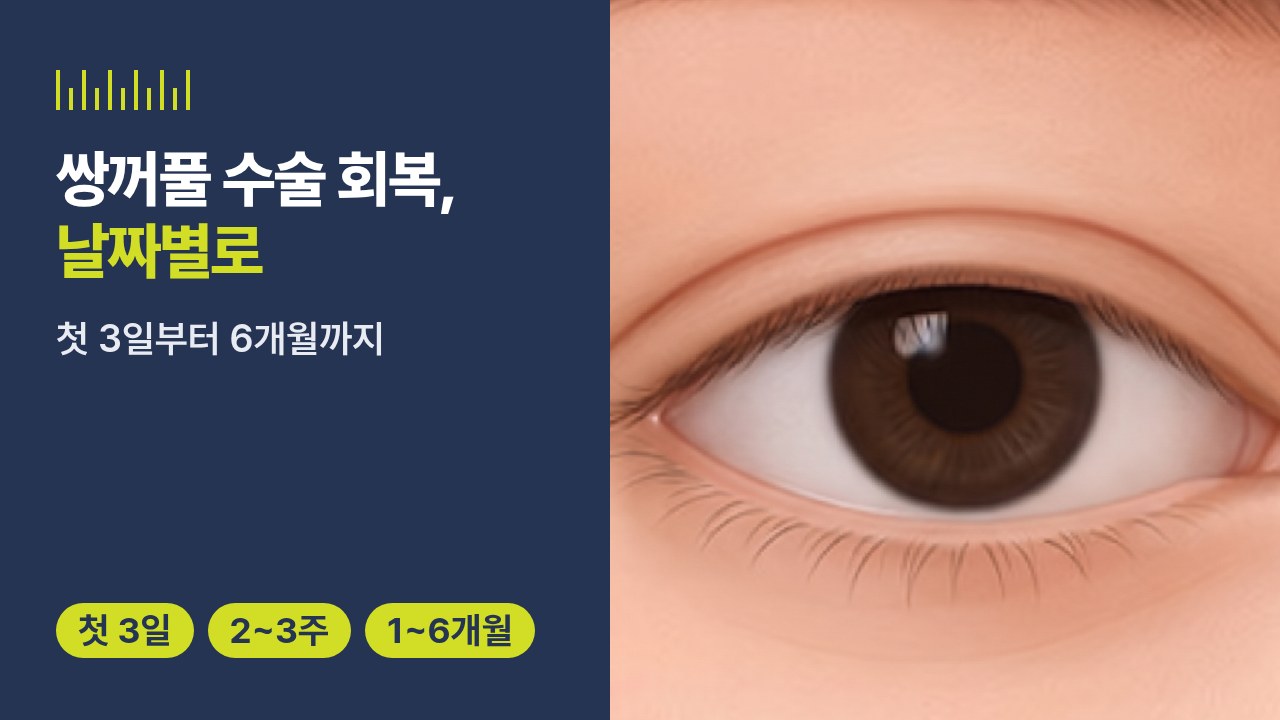
Recovery after double eyelid surgery does not finish overnight. What you see and the care you need change from one period to the next. This post splits recovery into the first 3 days, 2–3 weeks, and one to six months, and sets out what changes and what to do in each period. The time frames here describe a general pattern; they do not mean your own recovery will follow exactly the same schedule. The course of recovery may differ depending on the surgical method and extent and on your individual condition.

How does double eyelid surgery recovery unfold, day by day and month by month?
Recovery after double eyelid surgery can be broadly divided into three periods: the first 3 days, when swelling is at its greatest; 2–3 weeks, when swelling and bruising gradually fade; and one to six months, when the crease and the scar settle in.
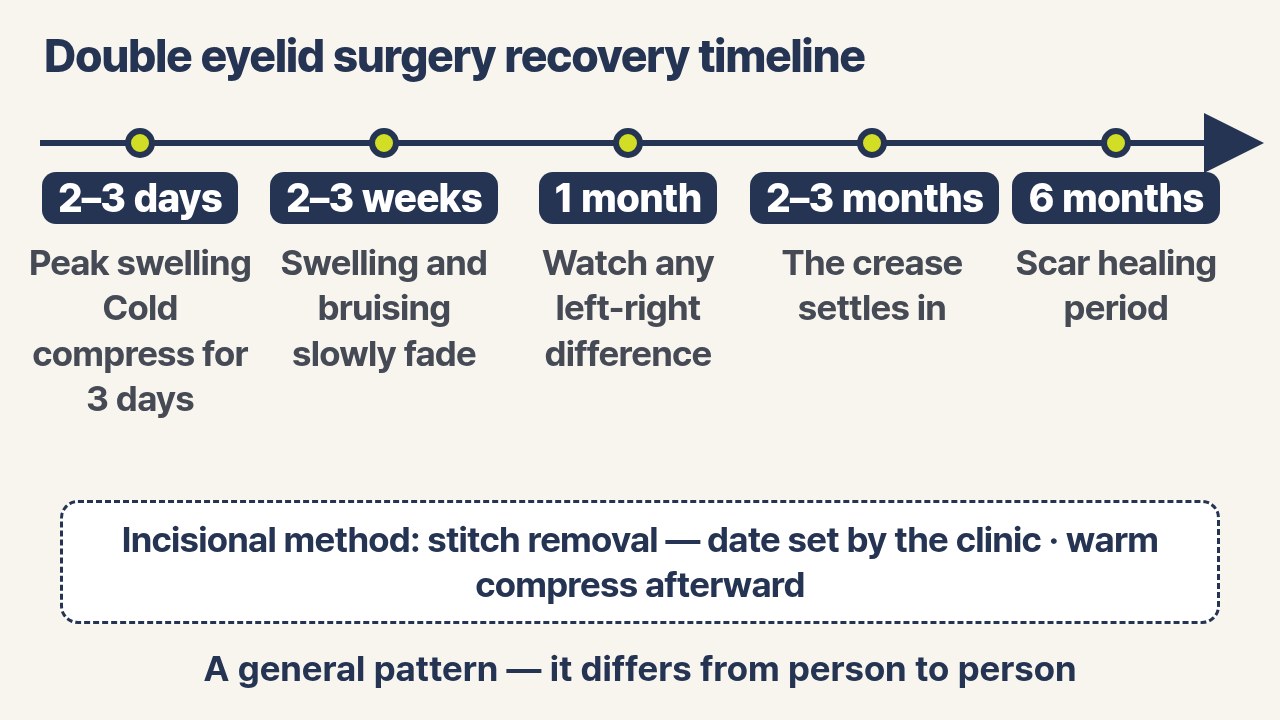
- 2–3 days after surgery — This is when swelling is at its worst. The eyelids may look thick.
- Stitch removal (incisional method) — The clinic tells you the date. After the stitches are removed, you switch from a cold compress to a warm compress.
- 2–3 weeks — It varies from person to person, but swelling and bruising usually last about 2–3 weeks and then gradually fade.
- 1 month — Even if the two sides look different, if there is no particular problem you watch how things progress for at least a month or so.
- 2–3 months to 6 months — The crease generally needs at least 2–3 months to settle, and the scar usually goes through about 6 months of healing.
Treat these time frames as a rough pattern
How fast you recover and how much you swell differ from person to person. It is better not to use the dates in other people’s reviews as the yardstick for your own recovery. Base your schedule on the follow-up dates and instructions given by the clinic that performed your surgery.
How should you spend the first 3 days after surgery?
For about 2–3 days after surgery, swelling is at its worst. Swelling at this stage is an inflammatory response caused by the surgery, so the eyelids may look thick and the crease may look deep. How your eyes look at this point is not the final result.
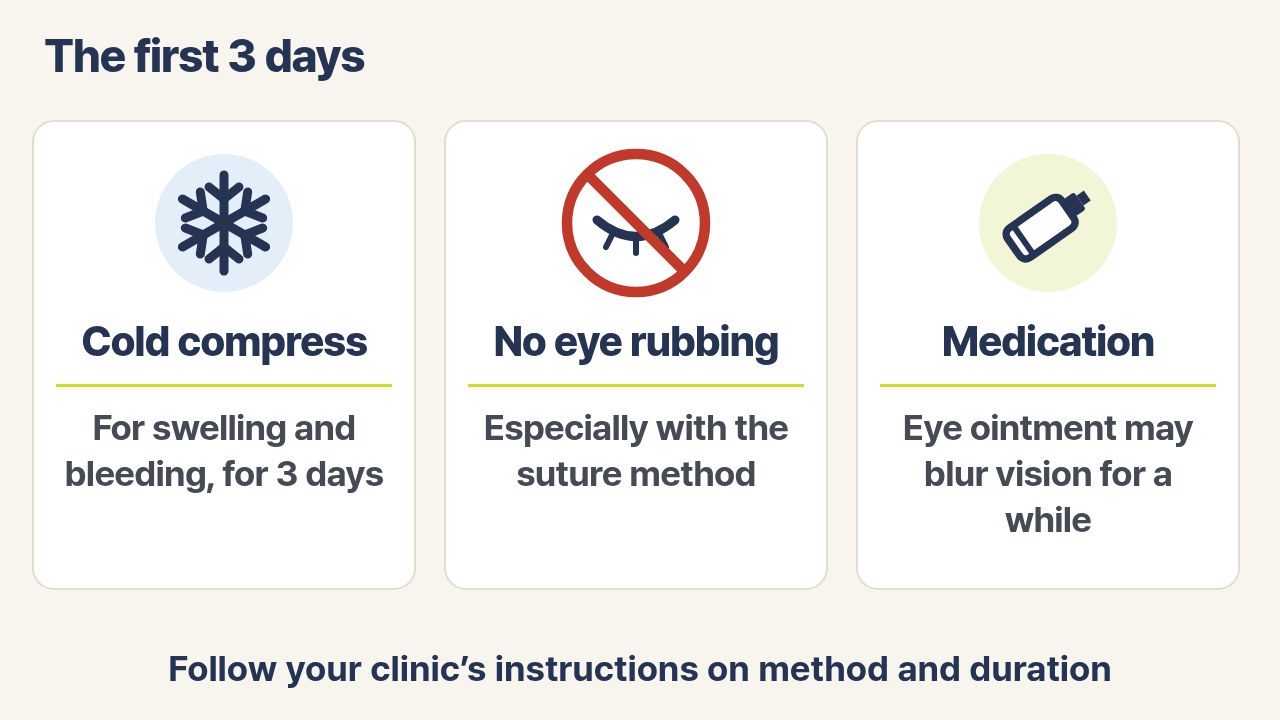
- Cold compress — Use a cold compress for 3 days after surgery to manage swelling and bleeding. Follow your clinic’s instructions on how to do it.
- No eye rubbing — With the suture method in particular, how you look after your eyes early in recovery can affect how the crease stabilises. Avoid irritation such as rubbing your eyes.
- Prescribed medication — Use your prescribed medication and eye ointment as instructed. Right after surgery, your vision may blur for a while because of the ointment or the swelling.
A common thought
My eyes look so thick in the mirror. Will the crease set like this?
A thick look in the first 3 days can appear while swelling is at its greatest. However, if pain you can hardly bear continues even after taking painkillers, or your vision keeps getting blurrier, tell the clinic that performed your surgery right away rather than waiting for your follow-up date.
From stitch removal to 2–3 weeks: what do you do while the swelling goes down?
It varies from person to person, but swelling and bruising usually last about 2–3 weeks and then gradually fade. During this period your eyes may look a little different from day to day, depending on how quickly the swelling goes down.
The incisional method involves cutting and stitching the skin, so you return to the clinic to have the stitches removed. The clinic that performed your surgery sets the date for stitch removal based on the surgical method and how you are healing. After the stitches are removed, you use a warm compress to help blood circulation.
During recovery, avoid the following as much as possible. When you can start them again depends on the method and how you are healing. So it helps your planning to ask the clinic before surgery or when your stitches are removed.
- Contact lenses — Ask when you can wear them again.
- Eye make-up — Ask when you can start wearing make-up around the eyes again.
- Spicy food — Ask how long to avoid it.
- Exercise that puts pressure on the eye area — Ask when you can do it again.
- Your next follow-up visit — Ask when to come in for stitch removal and to check your progress.
From one to six months, when do the crease and the scar settle?
Recovery continues even after most of the swelling and bruising has gone. The double eyelid crease generally needs at least 2–3 months to settle. If the skin is thick or the incision covers a wide area, it may gradually stabilise over 6 months or more.
The two eyes may not lose their swelling at the same pace, so during recovery one crease may look deeper or thicker than the other. If there is no particular problem, watch how things progress for at least a month or so and keep checking your recovery.
The incision scar also goes through a healing process. A double eyelid surgery scar usually needs about 6 months of healing. A few days or a few weeks after surgery, the scar is still in the middle of healing.
Even if you are not happy with the shape and are thinking about revision surgery, it is best to make that decision at least one year later. This is because an accurate assessment is possible only once the tissues of the eye have stabilised. However, depending on the surgeon’s judgement, revision is sometimes carried out earlier.
How does the recovery schedule differ between the suture method and the incisional method?
Double eyelid surgery is broadly divided into the suture method and the incisional method. When the method differs, the points to look after in your recovery schedule also differ slightly.
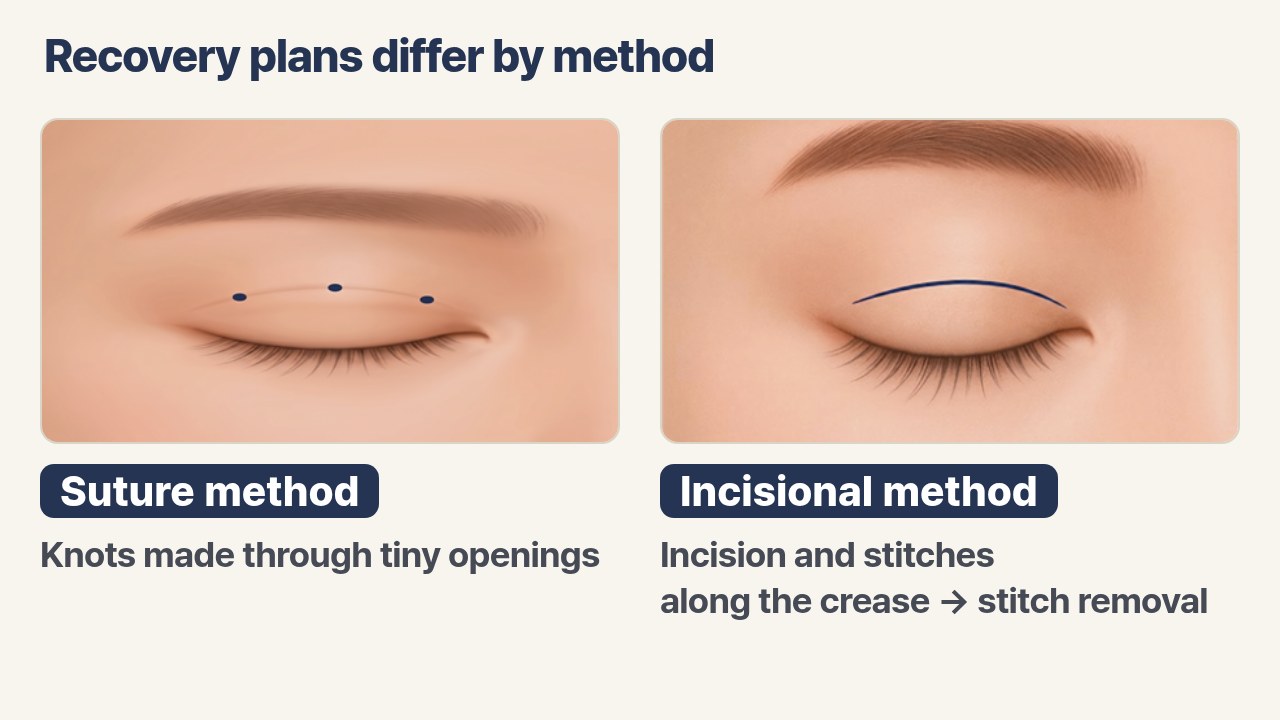
| Suture method | Incisional method | |
|---|---|---|
| How it is done | The crease is made by tying knots through tiny openings. | The skin is cut, some unnecessary fat and part of the muscle are removed, the crease is fixed, and the skin is stitched. |
| Stitches | With 1mm Plastic Surgery’s natural adhesion technique, the knots are tied inside the muscle so that no stitches show on the skin. Your follow-up visit schedule is explained at the consultation. | The skin is stitched, so you return to the clinic to have the stitches removed. |
| Recovery time | Because it is done through tiny openings, recovery time tends to be relatively short. | The scar usually goes through about 6 months of healing, and if the incision covers a wide area, the crease may take 6 months or more to stabilise. |
| Recommended for | Eyelids with thin, elastic skin and little sagging | Eyelids with thick skin or marked sagging |
| Points to consider during recovery | If the eyelid is thick or has a lot of fat, the incisional method may be suggested instead. Early care can affect how the crease stabilises, so avoid irritation such as rubbing your eyes. | Some unnecessary fat and part of the muscle can be removed, but a stitch-removal visit is needed, and you watch how the scar progresses while it heals. |
Which method suits you is decided at a consultation after checking factors such as eyelid skin thickness, sagging and the amount of fat.
You can read about each method on the 1mm Plastic Surgery website pages for the suture method (natural adhesion) and incisional double eyelid surgery.
How do you choose a surgery date that fits your recovery schedule?
How quickly swelling goes down varies a great deal from person to person, so it is better to check in advance and choose a surgery date that fits your own schedule. At the consultation, make sure you check the following.
- The first 3 days — Keep your schedule clear right after surgery so you can rest and use a cold compress. Check at the consultation how many days to keep free.
- Follow-up schedule — Check when you need to visit for stitch removal (incisional method) and progress checks.
- Important events — If you have an important event soon after surgery, mention it in advance and choose the surgery date together.
- Current medication and previous eye surgery — Please tell us at the consultation.
Side effects to be aware of
- Swelling, bruising and left-right difference — Swelling and bruising occur after surgery and the two sides may look different during recovery; how long they take to settle differs from person to person.
- Foreign-body sensation and dryness — Especially after the suture method, dry eye, irritation of the conjunctiva or chemosis (swelling of the conjunctiva) can make the eyes feel dry or gritty, and vision may be blurry.
- Scarring — The incision site may become hard, red and raised (a hypertrophic scar).
- Lumps and inflammation — A small lump may be felt around the stitched area, or inflammation may keep coming back.
- Problems with eye function — The eyes may not close completely, or in rare cases you may feel that your eye-opening strength has become weaker.
Contact the clinic that performed your surgery right away if
- Pain or pressure — pain you can hardly bear continues even after taking painkillers, or you feel pressure deep in the eye
- Changes in vision — your vision keeps getting blurrier over time, or you suddenly cannot see well
If you notice anything unusual, do not wait for your next follow-up date — tell the clinic that performed your surgery right away.
How to tell whether a symptom during recovery is part of normal healing or a side effect that needs medical attention is explained in detail in our earlier post (Swelling, Bruising, Asymmetry After Double Eyelid Surgery: Normal Recovery or Side Effect?).
Double eyelid surgery recovery: frequently asked questions
When should I use a cold compress and a warm compress after double eyelid surgery?
You use a cold compress for 3 days after surgery to manage swelling and bleeding, and a warm compress after the stitches are removed to help blood circulation. Follow your clinic’s instructions for the exact method and timing.
When can I wear contact lenses and eye make-up after double eyelid surgery?
You are advised to avoid contact lenses and eye make-up as much as possible during recovery. When you can start again depends on the surgical method and how you are healing, so ask the clinic before surgery or when your stitches are removed.
When are the stitches removed after incisional double eyelid surgery?
With the incisional method the skin is stitched, so you return to the clinic to have the stitches removed. The clinic that performed your surgery sets the date based on the surgical method and how you are healing. When choosing your surgery date, put this visit into your schedule as well.
If I am not happy with the shape, when should I decide on revision surgery?
An accurate assessment is possible only once the tissues of the eye have stabilised, so it is best to decide on revision at least one year later. However, depending on the surgeon’s judgement, revision is sometimes carried out earlier.
What we do at the consultation
We plan your recovery in advance,
together, just like the surgery
- Checking your eyes and the surgical method
- Explaining aftercare instructions
- Explaining stitch removal and follow-up visits
- Explaining side effects and when to contact us
We check the condition of your eyes and discuss the surgical method and recovery schedule. Results and the course of recovery may differ from person to person.
Consultation and booking
| Enquiries |
[email protected]
Getting in touch in advance can help reduce your waiting time. |
|---|---|
| Telephone | +82-2-552-1171 |
| +82 10-9451-1171 | |
| Opening hours |
Weekdays 10:00 – 19:00 Saturday 10:00 – 16:00 Closed Sundays and public holidays — for holiday opening, please check the monthly schedule notice. |
| Address | 7th, 8th, 9th and 10th floors, Youngshin Building, 449 Gangnam-daero, Seocho-gu, Seoul
In front of Exit 7, Sinnonhyeon Station — a 2-minute walk |
| Website | 1mmpsglobal.com |
#DoubleEyelidSurgery #DoubleEyelidRecovery #DoubleEyelidSwelling #IncisionalDoubleEyelid #SutureMethod #EyelidStitchesRemoval #DoubleEyelidSurgeryKorea #1mmPlasticSurgery #PtosisCorrectionKorea #EpicanthoplastySurgery
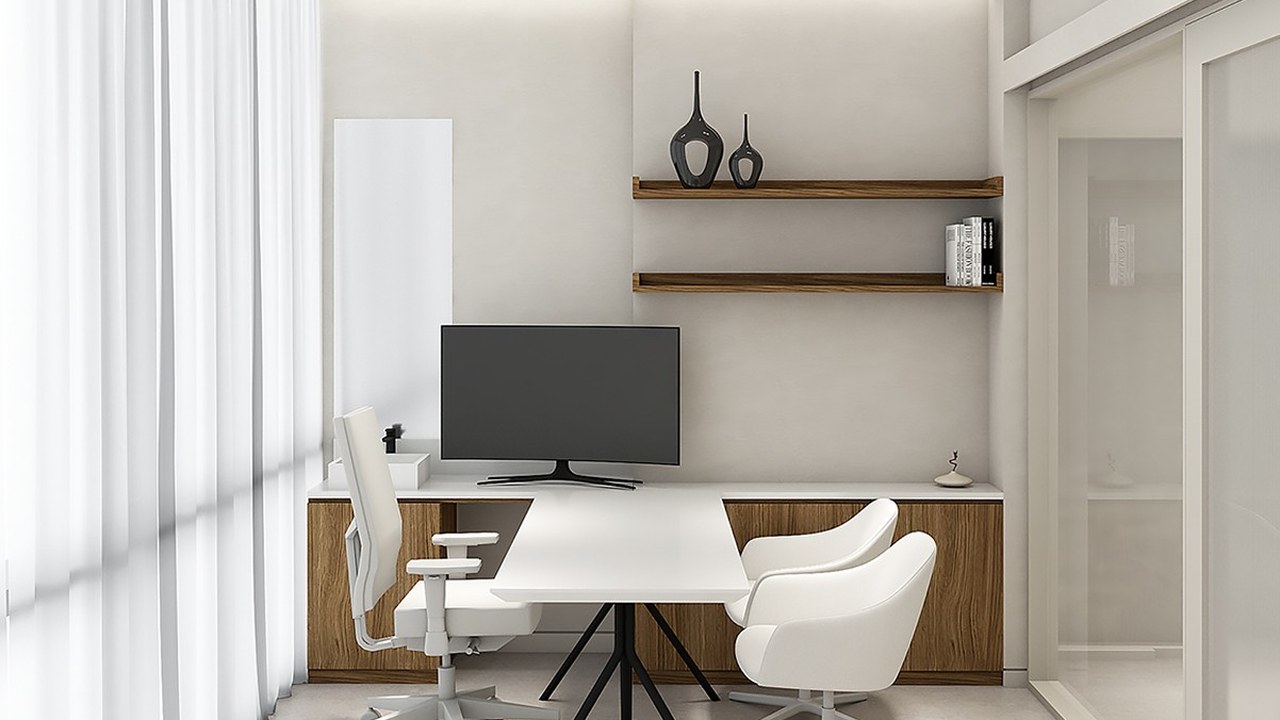
This post was written by the founder of a medical institution to provide medical information. The eye illustrations and diagrams in this post are explanatory images made to aid understanding and do not show real people or before-and-after results. The interior image is from the ‘Clinic tour’ on the website and may differ from the actual premises. For any surgery, its suitability for you, the result and the course of recovery may differ depending on the condition of your eyes, and side effects may occur. Please confirm the details through a consultation.
Clinic Info
Details
- 서울특별시 서초구 강남대로 449 영신빌딩 7, 8, 9, 10층
- 02-552-1171
- Mon-Fri 10:00-19:00Sat 10:00-16:00
- Director 도언록
- 1mmps.com